- Reports
- Business Case for Emotional Intelligence
- Do Emotional Intelligence Programs Work?
- Emotional Competence Framework
- Emotional Intelligence: What it is and Why it Matters
- Executives' Emotional Intelligence (mis) Perceptions
- Guidelines for Best Practice
- Guidelines for Securing Organizational Support For EI
- Johnson & Johnson Leadership Study
- Ontario Principals’ Council Leadership Study
- Technical Report on Developing Emotional Intelligence
- Measures
- Emotional Capital Report (ECR)
- Emotional Intelligence Quotient (EQ-i)
- Emotional & Social Competence Inventory 360 (ESCI)
- Emotional & Social Competence Inventory-University (ESCI-U)
- Geneva Emotional Competence Test
- Genos Emotional Intelligence Inventory (Genos EI)
- Team Emotional Intelligence (TEI)
- Mayer Salovey Caruso Emotional Intelligence Test (MSCEIT)
- Profile of Emotional Competence (PEC)
- Schutte Self-Report Inventory (SSRI)
- Six Seconds Emotional Intelligence Assessment (SEI)
- Trait Emotional Intelligence Questionnaire (TEIQue)
- Wong's Emotional Intelligence Scale
- Work Group Emotional Intelligence Profile (WEIP)
- References
- Model Programs
- Achievement Motivation Training
- Care Giver Support Program
- Competency-Based Selection
- Emotional Competence Training - Financial Advisors
- Executive Coaching
- Human Relations Training
- Interaction Management
- Interpersonal Conflict Management - Law Enforcement
- Interpersonal Effectiveness Training - Medical Students
- JOBS Program
- LeaderLAB
- Self-Management Training to Increase Job Attendance
- Stress Management Training
- Weatherhead MBA Program
- Williams' Lifeskills Program
- Article Reprints
- Members
- Events
- Bookstore
Apples and Applesauce
By: Daniel Goleman |
Download PDF
|
ARTICLE REFERENCE See Related Articles to This Thread
|
David Caruso’s insightful and well-balanced response characterizes the three main models of EI in terms of a framework hinted at in my essay with Robert Emmerling. Caruso then proposes that the three main models in the field each belong in a different domain: the Bar-On model reflecting a “trait” approach, my own a “competence” perspective, and the Mayer-Salovey model an “intelligence” theory.
While this seems reasonable, I feel a need to clarify this proposed categorization in terms of a more careful analysis of the relationship between a competence and the underlying intelligence upon which it builds. I believe that there may be a problem here with logical types – more specifically, that emotional intelligence and EI competence are intimately related, but not of the same order. Rather, one emerges from the other. Instead of apples and oranges, it’s apples and applesauce.
So the proposed division may have the unintended effect of obscuring important connections between aspects of emotional intelligence, by making them appear more unrelated than they actually are. Take as an analog the abilities of a gifted architect, which depend on a fundamental talent for spatial thinking. IQ tests include spatial thinking in the standard array of abilities they assess. However, simply scoring well on spatial abilities in itself would be insufficient for success as an architect – what’s needed in addition is years spent cultivating the ways the person can apply her talent in spatial thinking to what an architect does.
In other words, a gift for spatial thinking offers a platform upon which the craft of architecture can build. Architectural skill can be seen as an emergent property of spatial ability, one that only emerges with years of proper training. Likewise, the EI competencies are based on a platform of emotional intelligence, as I’ve proposed in my essay on this website, An EI-Based Theory of Performance
In a study of high-performers at Johnson & Johnson, each of these EI competencies was found to have a distinct developmental history over many years in a person’s life (Dreyfus & Mangino, 2001). For instance, a woman who was an outstanding team leader described how she had honed this EI competence beginning as a coach for her school’s field hockey team in junior high school. With each such iteration in the course of life, people can spontaneously build the skill sets that are identified in the organizational context as ‘EI competence’. Lacking such serendipitous experiences in life, people can intentionally cultivate any of the EI competences, with the proper model of learning.
One reason I and others talk about the “EI competencies” as such – and not just as “competencies” – is to make the identical distinction in the universe of competence models that John Mayer and Peter Salovey have established in arguing for EI to be considered an intelligence apart from IQ: EI encompasses abilities like emotional self-regulation that are not assessed by IQ tests. Such EI abilities draw on sub-cortical brain regions that are quite distinct from the neocortical areas that are the neural substrates for all purely cognitive abilities, like IQ (Bar-On, Tranel, Denburg, & Bechara, 2003). EI mingles neocortical and subcortical skills, combining affective and cognitive abilities.
This marks a fundamental difference from competencies like technical skills, which rely solely on purely cognitive, IQ-type abilities based in the neocortex. This difference among types of competence is of more than mere theoretical importance: when it comes to learning in this domain, the brain operates in a different way than is the case when we learn a technical skill. By ignoring this distinction, organizations stand to waste time and money on training approaches that are ineffective. The guidelines posted on this website for “Best Practices” in EI training outline the most effective ways to help people boost this skill set, in contrast to methods that work well for technical skills.
So whether one uses the term “emotional intelligence” or “EI competence” for this set of human abilities seems to me of less practical concern than whether the working relationship between the two levels are well understood.
References
Dreyfus, C. & Mangino, M. (2001, April). Developing emotional intelligence competencies. Paper presented at the meeting of the Consortium for Research on Emotional Intelligence in Organizations, Cambridge, MA.
Bar-On, R., Tranel, D., Denburg, N. L., & Bechara, A. (2003). Exploring the neurological substrate of emotional intelligence. Brain, 126, 1790-2000.

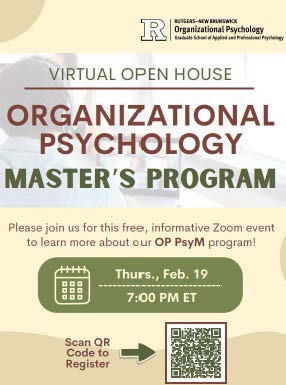
VIRTUAL OPEN HOUSE - Mon, Oct 27th 7:00 pm ET
 The Consortium for Research on Emotional Intelligence in Organizations is headquartered within the Organizational Psychology Program at Rutgers University and provides students with the unique opportunity to conduct research and collaborate with and learn from leading experts in the field of emotional intelligence. The Organizational Psychology program is currently accepting applications for our Master's (PsyM) program for matriculation in Fall 2026. Click here or scan the QR code below to register for our virtual open house to learn more.
NEW Research Fellowship
think2perform Research Institute’s Research Fellowship program invites proposals from doctoral candidates, post-docs and junior faculty pursuing self-defined research focused on moral intelligence, purpose, and/or emotional intelligence. Click here for more information.
Listen to Consortium member Chuck Wolfe interview some of the thought leaders in emotional intelligence.
Harvard Alumni Panel - Why is interest in Emotional Intelligence Soaring?
Consortium member Chuck Wolfe hosts a panel of world class leaders in the field of emotional intelligence (EI) to talk about why interest in EI is soaring. Panel members include EI Consortium members Dr. Richard Boyatzis, Dr. Cary Cherniss and Dr. Helen Riess. Click here to view the panel discussion.
Interview with Dr. Cary Cherniss and Dr. Cornelia Roche
Host, Chuck Wolfe interviews Drs. Cary Cherniss and Cornelia Roche about their new book Leading with Feeling: Nine Strategies of Emotionally Intelligent Leadership. The authors share powerful stories of cases involving outstanding leaders using strategies that can be learned that demonstrate effective use of emotional intelligence. Click here to see the interview.
Interview with Dr. Rick Aberman
See Chuck Wolfe interview Consortium member and sports psychologist Dr. Rick Aberman on peak performance and dealing with the pandemic. The interview is filled with insights, humorous anecdotes, and strategies for achieving peak performance in athletics and in life. Click here to see the interview.
Interview with Dr. David Caruso
Chuck Wolfe interviews Consortium member David Caruso talking about their work together, the ability model of emotional intelligence, and insights into how to use emotional intelligence to address staying emotionally and mentally healthy during times of crisis and uncertainty. Click here to listen to the interview.
Interview with Dr. Richard Boyazis
How can you help someone to change? Richard Boyatzis is an expert in multiple areas including emotional intelligence. Richard and his coauthors, Melvin Smith, and Ellen Van Oosten, have discovered that helping people connect to their positive vision of themselves or an inspiring dream or goal they've long held is key to creating changes that last. In their book Helping People Change the authors share real stories and research that shows choosing a compassionate over a compliance coaching approach is a far more engaging and successful way to Helping People Change. Click here to listen to the interview.
Interview with Dr. Marc Brackett
Marc Brackett, Director of the Yale Center for Emotional Intelligence, has written a wonderful book about feelings. I worked with Marc when he was first crafting his world class social and emotional learning program, RULER. Our interview highlights how Marc has achieved his own and his Uncle's vision for encouraging each of us to understand and manage our feelings. My conversation with Marc is inspiring, humorous, and engaging at times. Click here to listen to the interview.
Interview with Dr. Helen Riess
Helen Riess is a world class expert on empathy. She is an associate clinical professor of psychiatry at Harvard Medical School and director of the Empathy and Relational Science Program at Mass General Hospital. Helen discusses her new book and shares insights, learnings and techniques such as the powerful seven-step process for understanding and increasing empathy. She relates information and cases whereby she uses empathy to make a meaningful difference in areas such as parenting and leading. Click here to listen to the interview.
Interview with Dr. Maurice Elias
The show is about the Joys and Oys of Parenting, a book written by a respected colleague, Dr. Maurice Elias, an expert in parenting and emotional and social intelligence. Dr. Elias wrote a book tying Judaism and emotional intelligence together to help parents with the challenging, compelling task of raising emotionally healthy children. And while there are fascinating links to Judaism the book is really for everybody. Click here to listen to the interview.
Interview with Geetu Bharwaney
Challenges abound and life is stressful for many. So how do we cope? Chuck Wolfe interviews Geetu Bharwaney about her book, Emotional Resilience. Geetu offers research, insights, and most importantly practical tips for helping people bounce back from adversity. Click here to listen to the interview.
Interview with Dr. Daniel Goleman
Listen to an interview by with Dr. Goleman on his new book Focus: The Hidden Driver of Excellence. In the book Dan helps readers to understand the importance and power of the ability to focus one's attention, will power, and cognitive control in creating life success. Click here to listen to the interview.
Interview with Dr. John Mayer
How Personal Intelligence Shapes Our Lives: A Conversation with John D. Mayer. From picking a life partner, to choosing a career, Jack explains how personal intelligence has a major impact on our ability to make successful decisions. Click here to listen to the interview.
Interview with Dr. Cary Cherniss
Click HERE to listen to an interview with Dr. Cary Cherniss co-chair of the EI Consortium. Dr. Cherniss discusses the issue of emotional intelligence and workplace burnout.
Interview with Dr. Marc Brackett
Click HERE to listen to an interview with Dr. Marc Brackett, the newly appointed leader of the Center of Emotional Intelligence which will begin operation at Yale University in April, 2013. In this interview Dr. Brackett shares his vision for the new center.
