- Reports
- Business Case for Emotional Intelligence
- Do Emotional Intelligence Programs Work?
- Emotional Competence Framework
- Emotional Intelligence: What it is and Why it Matters
- Executives' Emotional Intelligence (mis) Perceptions
- Guidelines for Best Practice
- Guidelines for Securing Organizational Support For EI
- Johnson & Johnson Leadership Study
- Ontario Principals’ Council Leadership Study
- Technical Report on Developing Emotional Intelligence
- Measures
- Emotional Capital Report (ECR)
- Emotional Intelligence Quotient (EQ-i)
- Emotional & Social Competence Inventory 360 (ESCI)
- Emotional & Social Competence Inventory-University (ESCI-U)
- Geneva Emotional Competence Test
- Genos Emotional Intelligence Inventory (Genos EI)
- Team Emotional Intelligence (TEI)
- Mayer Salovey Caruso Emotional Intelligence Test (MSCEIT)
- Profile of Emotional Competence (PEC)
- Schutte Self-Report Inventory (SSRI)
- Six Seconds Emotional Intelligence Assessment (SEI)
- Trait Emotional Intelligence Questionnaire (TEIQue)
- Wong's Emotional Intelligence Scale
- Work Group Emotional Intelligence Profile (WEIP)
- References
- Model Programs
- Achievement Motivation Training
- Care Giver Support Program
- Competency-Based Selection
- Emotional Competence Training - Financial Advisors
- Executive Coaching
- Human Relations Training
- Interaction Management
- Interpersonal Conflict Management - Law Enforcement
- Interpersonal Effectiveness Training - Medical Students
- JOBS Program
- LeaderLAB
- Self-Management Training to Increase Job Attendance
- Stress Management Training
- Weatherhead MBA Program
- Williams' Lifeskills Program
- Article Reprints
- Members
- Events
- Bookstore
Emotional Intelligence - Dissertation Abstracts
The following list of dissertations represent research conducted in the area of emotions and emotional intelligence in organizational settings with adult populations. Click on a year below to jump to section.
[2015] [2014] [2013] [2012] [2011] [2010] [2009] [2008] [2007] [2006] [2005] [2004] [2003] [2002] [2001] [2000] [1998]
Adams, L. A. H. (2015). Utilization of emotional intelligence traits by public school superintendents in the state of Arkansas. Dissertation Abstracts International Section A: Humanities and Social Sciences, 75(7-A(E)).
Bergquist, K. E. (2015). Finding the right fit: Using organizational culture and emotional intelligence in the lead pastor search process. Dissertation Abstracts International Section A: Humanities and Social Sciences, 75(8-A(E)).
Butkiewicz, T. E. (2015). Examining first-line managers' leadership practices, emotional intelligence, and workplace spirituality in the manufacturing industry. Dissertation Abstracts International Section A: Humanities and Social Sciences, 75(8-A(E)).
Hargett-Neshyba, R. M. (2015). An examination of the relationship between emotional intelligence and transformational leadership of texas superintendents. Dissertation Abstracts International Section A: Humanities and Social Sciences, 75(9-A(E)).
Lindsey, N. S. (2015). Online education, emotional intelligence, and interpersonal skills for the 21st century workforce. Dissertation Abstracts International Section A: Humanities and Social Sciences, 75(8-A(E)).
McCarley, P. R. (2015). The influence of interpersonal and intrapersonal self-regulatory variables on performance outcomes of counseling interns. Dissertation Abstracts International: Section B: The Sciences and Engineering, 75(7-B(E)).
Wang, K.-B. (2015). The impact of gender and emotional intelligence on career commitment among senior undergraduate hotel management majors in Taiwan. Dissertation Abstracts International Section A: Humanities and Social Sciences, 75(8-A(E)).
Wilke, J. (2015). A new mixed model measure of Emotional Intelligence. Dissertation Abstracts International: Section B: The Sciences and Engineering, 75(8-B(E)).
Abdulkarim, R. M. (2014). The relationship between a leader's self-perceived level of emotional intelligence and organizational climate, as perceived by organizational members. Dissertation Abstracts International Section A: Humanities and Social Sciences, 74(11-A(E)).
Acha, V. (2014). The relationship between emotional intelligence of a leader and employee motivation to job performance. Dissertation Abstracts International Section A: Humanities and Social Sciences, 75(2-A(E)).
Adams, T. L. (2014). Leader emotional intelligence and workgroup engagement: A quantitative correlational study. Dissertation Abstracts International Section A: Humanities and Social Sciences, 74(12-A(E)).
Adewoye, A. (2014). Unique competencies required for female leadership success in the 21st century. Dissertation Abstracts International Section A: Humanities and Social Sciences, 75(3-A(E)).
Ashworth, S. R. (2014). The relationship between the emotional intelligence of secondary public school principals and school performance. Dissertation Abstracts International Section A: Humanities and Social Sciences, 74(9-A(E)).
Bartock, A. L. (2014). Fight or flight, stay or leave: The relationship between emotional intelligence and voluntary turnover. Dissertation Abstracts International Section A: Humanities and Social Sciences, 75(6-A(E)).
Bates, I. (2014). A correlational study of emotional intelligence and project leadership. Dissertation Abstracts International Section A: Humanities and Social Sciences, 75(3-A(E)).
Berry, D. O. (2014). Differences in emotional intelligence and team cohesiveness in men's and women's community college athletic teams. Dissertation Abstracts International: Section B: The Sciences and Engineering, 75(2-B(E)).
Brown, O. L. (2014). Employee retention during a leadership change. Dissertation Abstracts International Section A: Humanities and Social Sciences, 75(5-A(E)).
Bryant, N. (2014). Leadership development as a relational process: A grounded theory investigation of leader experiences. Dissertation Abstracts International Section A: Humanities and Social Sciences, 74(8-A(E)).
Burgan, D. S. (2014). A study of emotional intelligence levels of abilities of project management practitioners. Dissertation Abstracts International Section A: Humanities and Social Sciences, 74(10-A(E)).
Ceballos, G. A. (2014). The relationship between emotional intelligence and job satisfaction among nurses at a community hospital setting. Dissertation Abstracts International: Section B: The Sciences and Engineering, 75(5-B(E)).
Clanton, T. E., Jr. (2014). Emotional intelligence and performance of civilians in federal government. Dissertation Abstracts International Section A: Humanities and Social Sciences, 75(2-A(E)).
Covino, F. E. (2014). Cognitive distortions and gender as predictors of emotional intelligence. Dissertation Abstracts International: Section B: The Sciences and Engineering, 75(4-B(E)).
Davis, C. M. (2014). The impact of intervention methods on emotional intelligence. Dissertation Abstracts International Section A: Humanities and Social Sciences, 74(9-A(E)).
De La Cruz-Moraza, H. G. (2014). A correlational study of emotional intelligence and successful sales performance in puerto rico. Dissertation Abstracts International Section A: Humanities and Social Sciences, 75(5-A(E)).
Dillon, N. E. (2014). The relationship between emotional intelligence and leadership practices of human services adminstrators. Dissertation Abstracts International Section A: Humanities and Social Sciences, 75(3-A(E)).
Drager, K. A. (2014). Examining the ability of emotional intelligence and work location to predict job satisfaction. Dissertation Abstracts International Section A: Humanities and Social Sciences, 75(5-A(E)).
Fortner, A. N. (2014). The role of a leader's emotional intelligence and how it relates to employees' motivation and job satisfaction. Dissertation Abstracts International Section A: Humanities and Social Sciences, 74(7-A(E)).
Fox, C. J. (2014). Emotional intelligence and community healthcare productivity. Dissertation Abstracts International Section A: Humanities and Social Sciences, 75(4-A(E)).
Friedman, S. (2014). Teacher emotional intelligence and the quality of their interactions with students. Dissertation Abstracts International Section A: Humanities and Social Sciences, 75(6-A(E)).
Gayle, J. R. (2014). A quantitative study of the relationship between emotional intelligence and virtue ethics in accounting professionals. Dissertation Abstracts International Section A: Humanities and Social Sciences, 75(5-A(E)).
Glodstein, D. (2014). Examining the relationship between emotional intelligence of accountants and job satisfaction. Dissertation Abstracts International Section A: Humanities and Social Sciences, 75(3-A(E)).
Griffin, P. (2014). Emotional intelligence as a predictor of a sales manager's sales performance. Dissertation Abstracts International: Section B: The Sciences and Engineering, 75(3-B(E)).
Hammett, J. (2014). Examining teacher burnout using emotional intelligence quotients: A correlational study. Dissertation Abstracts International Section A: Humanities and Social Sciences, 74(9-A(E)).
Hill, T. K. (2014). The relationships among master's level counseling trainees' training level, emotional intelligence, and psychophysiological correlates of emotion regulation during a simulated counseling interaction. Dissertation Abstracts International: Section B: The Sciences and Engineering, 74(9-B(E)).
Hooper, L. A. (2014). Exploration of the project management practitioner's emotional intelligence competencies. Dissertation Abstracts International Section A: Humanities and Social Sciences, 75(4-A(E)).
Hovencamp, S. A. (2014). The relationship between thinking styles and emotional intelligence: An exploratory study of retail managers. Dissertation Abstracts International Section A: Humanities and Social Sciences, 75(4-A(E)).
Iannucci, B. A. (2014). Emotional intelligence: A quantitative study of the relationship among academic success factors and emotional intelligence. Dissertation Abstracts International Section A: Humanities and Social Sciences, 74(12-A(E)).
Jenkins, J. A. (2014). Emotional intelligence and the transformational leadership of female nonprofit leaders. Dissertation Abstracts International Section A: Humanities and Social Sciences, 74(8-A(E)).
Johnson, L. M. (2014). Emotional intelligence and leader-member exchange: Do emotional competencies matter? Dissertation Abstracts International Section A: Humanities and Social Sciences, 75(3-A(E)).
Jones, D. G. (2014). Medical providers' emotional intelligence: Relationships with patient satisfaction and treatment adherence. Dissertation Abstracts International: Section B: The Sciences and Engineering, 75(3-B(E)).
Jordan, C. D. (2014). An examination of emotional intelligence and leadership competencies among Black and White female middle managers. Dissertation Abstracts International Section A: Humanities and Social Sciences, 74(8-A(E)).
Juma, D. S. (2014). The relationship between emotional intelligence of principals and the overall organizational climate of public elementary schools. Dissertation Abstracts International Section A: Humanities and Social Sciences, 74(10-A(E)).
Konkin, J. (2014). The moderating effect of emotional labor on the relationships of emotional intelligence and adjustment with managerial job performance. Dissertation Abstracts International: Section B: The Sciences and Engineering, 74(9-B(E)).
Lesniak, R. S. (2014). A correlational study: Elements of emotional intelligence and leadership among technology leaders. Dissertation Abstracts International Section A: Humanities and Social Sciences, 74(12-A(E)).
Michelangelo, L. (2014). Emotional intelligence, emotional competency, and critical thinking skills in nursing and nursing education. Dissertation Abstracts International Section A: Humanities and Social Sciences, 75(2-A(E)).
Mula, D. M. (2014). Examining emotional intelligence and transformational leadership within u.s. army national guard leaders. Dissertation Abstracts International Section A: Humanities and Social Sciences, 74(10-A(E)).
Murray, A. A. (2014). The relationship between teachers' emotional intelligence and attrition intention. Dissertation Abstracts International Section A: Humanities and Social Sciences, 75(3-A(E)).
Onipede, V. Y. S. (2014). Emotional education: A case on the perceptions of secondary school teachers' emotional intelligence leadership training. Dissertation Abstracts International: Section B: The Sciences and Engineering, 75(3-B(E)).
Park, H. H. (2014). Determinants on mechanism of emotional marketing: Emotional intelligence, perception of emotional labor' action, efficacy and customer' coping strategy on customer satisfaction. Dissertation Abstracts International Section A: Humanities and Social Sciences, 75(2-A(E)).
Peterson, J. (2014). Compassion fatigue and emotional intelligence in physicians. Dissertation Abstracts International: Section B: The Sciences and Engineering, 74(9-B(E)).
Peterson, S. M. (2014). Human resource professionals' perceived effects of leader emotional intelligence on employee commitment at colleges and universities. Dissertation Abstracts International Section A: Humanities and Social Sciences, 75(6-A(E)).
Price, T. (2014). Emotional intelligence in medical laboratory science. Dissertation Abstracts International: Section B: The Sciences and Engineering, 74(10-B(E)).
Rice, E. W. (2014). The relationship between emotional intelligence, selfefficacy, and clinical performance in associate degree nursing students. Dissertation Abstracts International Section A: Humanities and Social Sciences, 75(2-A(E)).
Roark, C. S. (2014). A mixed methods study exploring the relationship between servant leadership and emotional intelligence. Dissertation Abstracts International Section A: Humanities and Social Sciences, 75(2-A(E)).
Robertson-Schule, L. L. (2014). An investigation of the relationships between emotional intelligence, engagement, and performance. Dissertation Abstracts International: Section B: The Sciences and Engineering, 75(6-B(E)).
Robinson, K. J. (2014). An examination of virtual teams: Exploring the relationship among emotional intelligence, collective team leadership, and team effectiveness. Dissertation Abstracts International: Section B: The Sciences and Engineering, 74(12-B(E)).
Rose, A. (2014). The relationship between team emotional intelligence and team interpersonal process effectiveness. Dissertation Abstracts International Section A: Humanities and Social Sciences, 75(5-A(E)).
Rupani, R. J. (2014). Exploring the emotional intelligence of obstetrics and gynecology medical residents. Dissertation Abstracts International: Section B: The Sciences and Engineering, 75(1-B(E)).
Stevens, W. (2014). Using emotional intelligence as a leadership strategy to make good leaders great. Dissertation Abstracts International Section A: Humanities and Social Sciences, 74(8-A(E)).
Strickland, R. (2014). An exploratory qualitative study of the relationship between an educational leader's emotional intelligence and effective teams. Dissertation Abstracts International Section A: Humanities and Social Sciences, 75(3-A(E)).
Tillman, Q. T. (2014). A study of emotional intelligence and service ability among North Carolina mental health professionals: Implications for research and practice. Dissertation Abstracts International: Section B: The Sciences and Engineering, 75(2-B(E)).
Trejo, A. (2014). Quantitative correlational study: Emotional intelligence and project outcomes among Hispanics in technology. Dissertation Abstracts International Section A: Humanities and Social Sciences, 75(3-A(E)).
Vargas, G. A. (2014). The role of emotional intelligence skills in the academic achievement of students pursuing associate degrees at a south texas college. Dissertation Abstracts International Section A: Humanities and Social Sciences, 74(10-A(E)).
Watts, D. L. (2014). The relationship of ethical behavior in the workplace to emotional intelligence and perceived leader integrity. Dissertation Abstracts International Section A: Humanities and Social Sciences, 74(10-A(E)).
Weiler, P. (2014). Emotional intelligence associated with accountability of individual corporate board of directors: A quantitative study. Dissertation Abstracts International Section A: Humanities and Social Sciences, 74(7-A(E)).
Weiszbrod, T. (2014). Quantitatively studying the relationship between emotional intelligence and leadership competencies in health care. Dissertation Abstracts International Section A: Humanities and Social Sciences, 74(7-A(E)).
Wilson, V. J. (2014). Emotional intelligence and nursing student retention. Dissertation Abstracts International Section A: Humanities and Social Sciences, 75(3-A(E)).
Zomer, L. (2014). The relationships among emotional intelligence, gender, coping strategies, and well-being in the management of stress in close interpersonal relationships and the workplace. Dissertation Abstracts International: Section B: The Sciences and Engineering, 74(8-B(E)).
Achee, J. E. (2013). Understanding the factors that affect project managers' development and use of emotional intelligence in managing project stakeholders. Dissertation Abstracts International Section A: Humanities and Social Sciences, 74(5-A(E)).
Atwood, S. E. (2013). The relationship between emotional intelligence and decision-making style among healthcare leaders in Iowa. Dissertation Abstracts International: Section B: The Sciences and Engineering, 74(2-B(E)).
Baker, W. L. (2013). Emotional intelligence and conflict resolution styles: Implications for United States National Guard leaders. Dissertation Abstracts International Section A: Humanities and Social Sciences, 74(2-A(E)).
Bare, A. L. (2013). The relationship between emotional intelligence of school principals and their ability to identify the strengths or talents of a member of their leadership team. Dissertation Abstracts International Section A: Humanities and Social Sciences, 74(2-A(E)).
Beaman, J. M. (2013). A qualitative phenomenological study of emotional intelligence: Effects of stress on small business leaders. Dissertation Abstracts International Section A: Humanities and Social Sciences, 73(9-A(E)).
Bharamanaikar, S. R. (2013). Impact of emotional intelligence on leadership effectiveness, success and job satisfaction. Dissertation Abstracts International Section A: Humanities and Social Sciences, 73(7-A(E)).
Bhattacharya, M. (2013). Emotional intelligence in Indian executives. Dissertation Abstracts International Section A: Humanities and Social Sciences, 73(8-A(E)).
Billing, P. (2013). A study of emotional intelligence, thinking styles, and selling effectiveness of pharmaceutical sales representatives. Dissertation Abstracts International Section A: Humanities and Social Sciences, 74(1-A(E)).
Borkowski, T. M. (2013). Emotional intelligence: A key to improving federal chief information officer management. Dissertation Abstracts International Section A: Humanities and Social Sciences, 74(6-A(E)).
Brandal, K. M. (2013). The relationship between emotional intelligence and communication apprehension in job fair attendees. Dissertation Abstracts International Section A: Humanities and Social Sciences, 73(7-A(E)).
Campbell, G., Jr. (2013). The relationship among emotional intelligence and leadership styles of law enforcement executives. Dissertation Abstracts International Section A: Humanities and Social Sciences, 73(8-A(E)).
Chancler, J. (2013). A comparison of emotional intelligence and leadership styles among Texas public school principals. Dissertation Abstracts International Section A: Humanities and Social Sciences, 74(5-A(E)).
Cox, S. J. (2013). A study of personality, emotional intelligence, social maturity, and job performance among nurses in rural east Texas. Dissertation Abstracts International Section A: Humanities and Social Sciences, 73(10-A(E)).
Farnham, B.-C. (2013). Exploring impacts of emotional intelligence, gender and tenure on sales performance among hospice sales professionals. Dissertation Abstracts International Section A: Humanities and Social Sciences, 73(7-A(E)).
Gahan, B. C. (2013). A study of the relationship between emotional intelligence and individual performance in an inbound North American call center. Dissertation Abstracts International Section A: Humanities and Social Sciences, 73(8-A(E)).
Gardner, M. J., III. (2013). An explanatory study: The relationship of emotional intelligence, organizational culture, and performance ratings. Dissertation Abstracts International Section A: Humanities and Social Sciences, 74(1-A(E)).
Hokeness, M. M. (2013). The relationship of certified flight instructors' emotional intelligence levels on flight student advancement. Dissertation Abstracts International Section A: Humanities and Social Sciences, 74(4-A(E)).
Jones, V. D. (2013). The relationship between emotional intelligence and leadership effectiveness among sponsored research administrators. Dissertation Abstracts International Section A: Humanities and Social Sciences, 73(10-A(E)).
Kaplowitz, M. J. (2013). Impact of therapist emotional intelligence on psychotherapy, and, relevance of therapist emotional intelligence for psychotherapy. Dissertation Abstracts International: Section B: The Sciences and Engineering, 73(8-B(E)).
Kibben, C. (2013). Humor and emotional intelligence: A correlational study of leadership. Dissertation Abstracts International Section A: Humanities and Social Sciences, 74(5-A(E)).
Leigh, C. (2013). Examining the relationship between emotional intelligence and leadership styles of U.S. Navy senior enlisted leaders. Dissertation Abstracts International Section A: Humanities and Social Sciences, 74(1-A(E)).
Lilley, D. L. (2013). Applying positive leadership principles to an investigation of organizational stress in military units and the benefits associated with providing leaders with emotional intelligence social awareness. Dissertation Abstracts International: Section B: The Sciences and Engineering, 74(3-B(E)).
McDonnell, H. N. (2013). Examining job satisfaction, emotional intelligence, and servant leadership: A correlational research design. Dissertation Abstracts International Section A: Humanities and Social Sciences, 73(8-A(E)).
McLaughlin, E. B. (2013). An emotional business: The role of emotional intelligence in entrepreneurial success. Dissertation Abstracts International Section A: Humanities and Social Sciences, 74(4-A(E)).
Megowan, G. (2013). A correlation study of emotional intelligence and behavioral style of bio-pharmaceutical industry District Sales Managers. Dissertation Abstracts International Section A: Humanities and Social Sciences, 74(3-A(E)).
Noe, J. (2013). The relationship between principal's emotional intelligence quotient, school culture, and student achievement. Dissertation Abstracts International Section A: Humanities and Social Sciences, 74(4-A(E)).
Osborne, A. M. (2013). The relationship between emotional intelligence and leadership practices among physicians. Dissertation Abstracts International Section A: Humanities and Social Sciences, 73(12-A(E)).
Parks, A. M. (2013). Beyond the scoreboard: Examining the effects of emotional intelligence and coaching efficacy on the transformational leadership of collegiate coaches. Dissertation Abstracts International Section A: Humanities and Social Sciences, 74(5-A(E)).
Pittman, R. E. (2013). Emotional intelligence in charter school principals and student performance. Dissertation Abstracts International Section A: Humanities and Social Sciences, 74(3-A(E)).
Ray, S. E. (2013). Impact of training intervention on emotional intelligence in health care administrators and physician leaders. Dissertation Abstracts International Section A: Humanities and Social Sciences, 74(1-A(E)).
Sawhney, S. (2013). Effects of the TM technique on anxiety, emotional intelligence and trust: Implications for supply chain management. Dissertation Abstracts International Section A: Humanities and Social Sciences, 74(1-A(E)).
Schlott, J. L. (2013). Retail managers' situational leadership style and emotional intelligence. Dissertation Abstracts International Section A: Humanities and Social Sciences, 74(3-A(E)).
Seader, J. R. (2013). Examining the relationship between emotional intelligence and counterproductive work behaviors with a food service sample. Dissertation Abstracts International Section A: Humanities and Social Sciences, 74(5-A(E)).
Shank, J. C. (2013). Emotional intelligence and educational leadership: Measuring the emotional intelligence of educational leaders and their corresponding student achievement. Dissertation Abstracts International Section A: Humanities and Social Sciences, 73(9-A(E)).
Thor, S. (2013). Organizational excellence: A study of the relationship between emotional intelligence and work engagement in process improvement experts. Dissertation Abstracts International Section A: Humanities and Social Sciences, 74(4-A(E)).
Thornqvist, N. S. (2013). Emotional intelligence and burnout among teachers in a rural Florida school district. Dissertation Abstracts International Section A: Humanities and Social Sciences, 74(3-A(E)).
Wanser, D. L. (2013). The emotional intelligence of general counsels in relation to lawyer leadership. Dissertation Abstracts International Section A: Humanities and Social Sciences, 73(7-A(E)).
Wiljanen, D. (2013). Emotional intelligence, career decision difficulties, and student retention: A quantitative study. Dissertation Abstracts International Section A: Humanities and Social Sciences, 74(5-A(E)).
Yarick, L. L. (2013). An examination of leadership styles and emotional intelligence with behavioral healthcare service providers in a healthcare organization. Dissertation Abstracts International: Section B: The Sciences and Engineering, 73(12-B(E)).
Cobbs, R. (2012). Is the emotional intelligence of secondary school principals correlated with the job satisfaction or performance of their teachers? Ed.D. 3494831, University of Kansas, United States -- Kansas.
Farnham, B. (2012). Exploring Impacts of Emotional Intelligence, Gender and Tenure on Sales Performance Among Hospice Sales Professionals. Ed.D. 3501884, Northcentral University, United States -- Arizona.
Gahan, B. (2012). A Study of the Relationship Between Emotional Intelligence and Individual Performance in an Inbound North American Call Center. Ed.D. 3503013, Grand Canyon University, United States -- Arizona.
Thor, S. (2012). Organizational Excellence: A Study of the Relationship Between Emotional Intelligence and Work Engagement in Process Improvement Experts. Doctor of Management, George Fox University, United States -- Oregon.
Wanser, D. (2012). The emotional intelligence of general counsels in relation to lawyer leadership. Ed.D. 3499361, Pepperdine University, United States -- California.
Bennett, D. (2011). Examining the Relationship Between Emotional Intelligence of Managers and Organizational Commitment of Subordinates. Ph.D. Northcentral University, United States -- Arizona.
Cahill, A. (2011). Use of teams to accomplish radical organization change: Examining the influence of team cognitive style and leader emotional intelligence. Ph.D. Columbia University, United States -- New York.
Kirkland, K. (2011). The effect of emotional intelligence on emotional competence and transformational leadership. Ph.D. City University of New York, United States -- New York.
Mehrotra, S. (2011). Effect of emotional intelligence training on managerial effectiveness of middle line mangers. Ph.D. Panjab University. India -- Chandigarh.
Smallidge, T. (2011). Factors affecting the relationship between emotional intelligence and job performance: A study of potential moderating variables. Ph.D. Alliant International University, Los Angeles, United States -- California.
Vargo Williams, L. (2011). A model of interpersonal trust from an individual differences perspective: The effects of cognition, affect, and self-monitoring. Ph.D. State University of New York at Buffalo, United States -- New York.
Wiswell, C. L. (2011). Superintendent Emotional Intelligence and Student Achievement: A Quantitative Study. Ed.D., Texas Tech University, United States -- Texas.
Zak-Abrantes, V. (2011). Enhancing student leaders' emotional intelligence through multi-dimensional executive coaching: A pragmatic case study approach. Psy.D. Rutgers The State University of New Jersey, Graduate School of Applied and Professional Psychology, United States -- New Jersey.
Andonian, L. (2010). Emotional intelligence, perceived clinical self efficacy, and occupational therapy interns' clinical competence. Ph.D. Saybrook Graduate School and Research Center, United States -- California.
Ball, L. (2010). Understanding emotional intelligence in nursing. Ph.D. State University of New York at Buffalo, United States -- New York.
Bethards, T. (2010). An analysis of the outcomes of an individual's investment decisions relative to their emotional intelligence. D.B.A. Anderson University, United States -- Indiana.
Carrick, L. (2010). Understanding the impact of a half day learning intervention on emotional intelligence competencies An exploratory study. Ed.D. University of Pennsylvania, United States -- Pennsylvania.
Ellis, A. (2010). Exploring the relationship of emotional intelligence and conflict management styles. Ph.D. The University of North Carolina at Greensboro, United States -- North Carolina.
Farouk, S. (2010). Investigating the relationship between emotional intelligence and high managerial performance in selected corporations in Belgium and Malaysia. Ph.D. Indiana University, United States -- Indiana.
Field, M. (2010). An investigation of the moderating effect of emotional intelligence on attitudes towards work and family. Ph.D. Columbia University, United States -- New York.
Hand, C. (2010). The effect of emotional intelligence as it relates to Army civilian leaders' use of consideration and initiating structure. Ph.D. The University of Oklahoma, United States -- Oklahoma.
Kaur, J. (2010). A mixed method case study: Bar-On EQ-i framework of emotional intelligence and the school leadership experiences of principals who completed an urban leadership program in northern California. Ed.D. University of San Francisco, United States -- California.
Kim, K. (2010). The influence of emotional intelligence on the negotiation outcomes and the mediation effects of rapport, negotiatiion strategy, and judgment accuracy. Ph.D. Southern Illinois University at Carbondale, United States -- Illinois.
Labby, S. (2010). The relationship among principals' emotional intelligence skills with respect to school accountability ratings and selected demographic factors. Ed.D. Sam Houston State University, United States -- Texas.
Lee, H. (2010). The relationship between emotional intelligence and emotional labor and its effect on job burnout in Korean organizations. Ph.D. University of Minnesota, United States -- Minnesota.
Lewis, T. (2010). The influence of authenticity and emotional intelligence on the relationship between self-monitoring and leadership effectiveness. Ph.D. Alliant International University, Los Angeles, United States -- California.
McNevin, M. (2010). How executive coaches assess and develop emotional intelligence in the executive suite. Ed.D. University of Pennsylvania, United States -- Pennsylvania.
Ohlson, S. (2010). Emotional Intelligence of Front-line Nurse Managers. Ph.D. University of Illinois at Chicago, Health Sciences Center, United States -- Illinois.
Rader, M. (2010). The relationship between emotional-social intelligence and social problem solving. Ph.D. Northern Arizona University, United States -- Arizona.
Radford, M. (2010). Emotional Intelligence as a Predictor of Nursing Student Success. Ed.D. Union University, United States -- Tennessee.
Radnitzer, K. (2010). Emotional intelligence and self-directed learning readiness among college students participating in a leadership development program. Ph.D. University of Illinois at Urbana-Champaign, United States -- Illinois.
Ramos-Villarreal, J. (2010). Exploring university students' development of Emotional Intelligence skills for leadership. Ed.D. Texas A&M University - Kingsville, United States -- Texas.
Roberson, E. (2010). What is the relationship between emotional intelligence and administrative advancement in an urban school division? Ph.D. Virginia Commonwealth University, United States -- Virginia.
Sebastijanovic, M. (2010). Antecedents and outcomes of emotional labor. Ph.D. University of Houston, United States -- Texas.
Shipp, D. (2010). Examining the relationship between emotional intelligence competencies and student persistence factors for full-time, traditional-aged college undergraduate students. Ed.D. University of the Pacific, United States -- California.
Sobocinski, C. (2010). Influence of emotional intelligence on group insurance representatives with high and low gross income. Ed.D. Dowling College, United States -- New York.
Stevens, C. (2010). Examining the relationship among personal-career turnover, emotional intelligence, stress, and coping among Nursing Home Administrators. Ph.D. Marywood University, Scranton, United States – Pennsylvania.
Turner, B. (2010). A study of the emotional quotient of nursing managers compared to the outcome of an employee opinion survey. Ed.D. Pepperdine University, United States -- California.
Wilson, T. (2010). Self-awareness and school leadership development: The case for transformative practice. Ed.D. Teachers College, Columbia University, United States -- New York.
Wolf, T. (2010). Examination of emotional intelligence and transformational leadership profiles of Illinois superintendents. Ed.D. Northern Illinois University, United States -- Illinois.
Zumdahl, L. (2010). The perceived managerial and leadership effectiveness of nonprofit leaders. Ph.D. 3410325, Cardinal Stritch University, United States -- Wisconsin.
Alston, B. (2009). An examination of the relationship between emotional intelligence and leadership practices. D.B.A. Nova Southeastern University, United States -- Florida.
Carbone, K. (2009). Evaluation of a leadership development program: Investigating the impact and key factors facilitating or impeding success. Psy.D. Rutgers The State University of New Jersey, Graduate School of Applied and Professional Psychology, United States -- New Jersey.
Coco, C. (2009). Emotional intelligence and job satisfaction: The EQ relationship for deans of U.S. business schools. D.B.A. Anderson University, United States -- Indiana.
Cooper, K. (2009). The effectiveness of business leadership practices among principals on student achievement on public school campuses in Texas. Ed.D. University of North Texas, United States -- Texas.
Curry, C. (2009). Correlation of emotional intelligence of school leaders to perceptions of school climate as perceived by teachers. Ed.D. Indiana University of Pennsylvania, United States -- Pennsylvania.
De Vito, N. (2009). The relationship between teacher burnout and Emotional Intelligence: A pilot study. Psy.D. Fairleigh Dickinson University, United States -- New Jersey.
Dziewior, J. (2009). Emotional intelligence: The contribution to leadership skills in female Catholic elementary school principals. Ed.D. Edgewood College, United States -- Wisconsin.
Eichmann, K. (2009). The effectiveness of training to improve the emotional intelligence of leaders. Ph.D. TUI University, United States -- California.
Farlow, M. (2009). The possible relationship between emotional intelligence and performance in Small Business Development Center regional groups in Texas. Ph.D. University of the Incarnate Word, United States -- Texas.
Flores, J. (2009). The relationships between emotional intelligence and the effectiveness of school leaders. Ph.D. Gonzaga University, United States -- Washington.
Freel, M. (2009). An exploratory study of emotional intelligence in clinical nurses. Ph.D. The University of Nebraska - Lincoln, United States -- Nebraska.
Ganus, M. (2009). A construct validity study of the Mayer-Salovey-Caruso Emotional Intelligence Test V2.0 with CASE/Carnegie U.S. "Professor of the Year" award winners. Ed.D. Seattle University, United States -- Washington.
Gordon-Handler, L. (2009). The relationship between emotional intelligence and clinical performance in an occupational therapy training program. Ph.D. Northcentral University, United States -- Arizona.
Helweg, N. (2009). An exploratory study of wilderness trip leaders' transformational leadership abilities, emotional intelligence, and perceived effectiveness. Ph.D. Gonzaga University, United States -- Washington.
Hsieh, C. (2009). Emotional labor in public service roles: A model of dramaturgical and dispositional approaches. Ph.D. The Florida State University, United States -- Florida.
Huntington, S. (2009). Correlational study between emotional intelligence scores and specific personality traits of professionals working in the nonprofit sector in the northwest. Ed.D. Pepperdine University, United States -- California.
Jellig, G. (2009). How do experienced versus transitioning principals employ behavioral emotional intelligence in leading schools. Ed.D. University of Pennsylvania, United States -- Pennsylvania.
Jerome, K. (2009). An examination of the relationship between emotional intelligence and the leadership styles of early childhood professionals. Ph.D. The University of Oklahoma, United States -- Oklahoma.
Kaiser, K. (2009). Emotional intelligence abilities of the physician executive. Ed.D. University of La Verne, United States -- California.
Knight, A. (2009). The effectiveness of counselor skills training and its relationship with emotional intelligence. Ph.D. 3353962, Regent University, United States -- Virginia.
Lussiez, Y. (2009). The empathic principal: The relationship between empathy, transformational leadership, and teacher self-efficacy. Ed.D. The University of New Mexico, United States -- New Mexico.
Lussiez, Y. (2009). The empathic principal: The relationship between empathy, transformational leadership, and teacher self-efficacy. Ed.D. The University of New Mexico, United States -- New Mexico.
Manahan, R. (2009). The other side of leadership: An examination of strategies and protocols for developing Emotional Intelligence in school administrators. Ed.D. University of Washington, United States -- Washington.
Meers, R. (2009). How effective leaders learn from life: A grounded theory study of the impact of significant life experiences on leadership development. Ph.D. The University of Nebraska - Lincoln, United States -- Nebraska.
Pardee, D. (2009). Emotional intelligence and job satisfaction among mental health professionals. Ph.D. Northern Arizona University, United States -- Arizona.
Rey, D. (2009). How leaders learn to be successful during large-scale organizational change. Ed.D. Teachers College, Columbia University, United States -- New York.
Rose, S. (2009). Assessing Emotional Intelligence among information technology and non-information technology professionals. Ph.D. Northcentral University, United States -- Arizona.
Sanders, S. (2009). Emotional intelligence, a necessary component of educational leadership programs, as perceived by professors of educational leadership. Ed.D. Sam Houston State University, United States -- Texas.
Shanklin, S. (2009). Professional learning communities: People leading change. Ed.D. University of Pennsylvania, United States -- Pennsylvania.
Shepherd-Osborne, T. (2009). Assessing the relationship between emotional intelligence and organizational commitment among early childhood educators. Ph.D. Northcentral University, United States -- Arizona.
Stang, M. (2009). A study of the relationship between the leadership styles and emotional intelligence of residential student leaders. Ed.D. Pepperdine University, United States -- California.
Tung, L. (2009). The emotional intelligence and attitudes toward globalization of future engineering professionals. Ed.D. Spalding University, United States -- Kentucky.
Waddell, J. (2009). Exploratory study of the relationship between servant leadership attribution and the leader's emotional intelligence. Ph.D. Regent University, United States -- Virginia.
Watson, P. (2009). Principal leadership: A case study of a district leadership academy. Ed.D. University of Kentucky, United States -- Kentucky.
Whitman, D. (2009). Emotional intelligence and leadership in organizations: A meta-analytic test of process mechanisms. Ph.D. Florida International University, United States -- Florida.
Barry, W. (2008). Emotional intelligence and relational trust. Ed.D. University of Virginia, United States -- Virginia.
Bumphus, A. (2008). The emotional intelligence and resilience of school leaders: An investigation into leadership behaviors. Ph.D. The University of Southern Mississippi, United States -- Mississippi.
Cates, L. (2008). The role of emotional intelligence in the management of nonprofit human service organizations. Ph.D. Columbia University, United States -- New York.
Davis-Barkley, J. (2008). How do emotionally intelligent salespeople leverage their talents differently? Ed.D. Teachers College, Columbia University, United States -- New York.
Diaz, A. (2008). Leadership training and emotional intelligence in school nurses. Ph.D. University of Nevada, Las Vegas, United States -- Nevada.
Hamilton, D. (2008). Examination of the relationships between emotional intelligence and mortgage sales productivity. Ph.D. Northcentral University, United States -- Arizona.
Jackson, C. (2008). An analysis of the emotional intelligence and personality of principals leading professional learning communities. Ed.D. University of North Texas, United States -- Texas.
Martin, C. (2008). A meta-analytic investigation of the relationship between emotional intelligence and leadership effectiveness. Ed.D. East Carolina University, United States -- North Carolina.
Maul, A. (2008). Improving the measurement of emotional intelligence. Ph.D. University of California, Berkeley, United States -- California.
Millan, R. (2008). Examining emotional intelligence differences among nursing students at a college in South Texas. Ed.D. Texas A&M University - Kingsville, United States -- Texas.
Muyia, M. (2008). A leadership training program and its effects of participants' emotional intelligence scores. Ed.D. University of Arkansas, United States -- Arkansas.
Palmer, L. (2008). Connections---A study of leadership and influence. Ed.D. University of Pennsylvania, United States -- Pennsylvania.
Petran, M. (2008). An exploratory study of executive transformational leadership, wisdom, and emotional intelligence in management process turnaround situations. Ed.D. Pepperdine University, United States -- California.
Sanville, J. (2008). The relationship between teacher perceptions of principal emotional intelligence and organizational health. Ed.D. University of Virginia, United States -- Virginia.
Solan, A. (2008). The relationships between emotional intelligence, visionary leadership, and organizational citizenship behavior in continuing higher education. Ph.D. Regent University, United States -- Virginia.
Stewart, G. (2008). The relationship of emotional intelligence to job satisfaction and organization commitment. Ph.D. Regent University, United States -- Virginia.
Vieira, R. (2008). Exploring the relationship between emotional competence and leadership performance in corporate managers. Psy.D. Rutgers The State University of New Jersey, Graduate School of Applied and Professional Psychology, United States -- New Jersey.
Yoon, J. (2008). Emotional intelligence and leadership effectiveness: The verbal and nonverbal communication behaviors of emotionally intelligent leaders. Ph.D. City University of New York, United States -- New York.
Bowman, J. (2007). The utility of emotional intelligence as a predictor of school psychologists' clinical competence. Psy.D. St. John's University (New York), United States -- New York.
Crowne, K. (2007). The relationships among social intelligence, emotional intelligence, cultural intelligence and cultural exposure. Ph.D. Temple University, United States -- Pennsylvania.
Drew, T. L. (2007). The relationship between emotional intelligence and student teacher performance. DigitalCommons@University of Nebraska - Lincoln 2007-01-01T08:00:00Z. ERIC #ED499558.
Gasiorowska, G. (2007). A study of project managers' most dominant emotional intelligence abilities and skills. Ed.D. Pepperdine University, United States -- California.
Gooty, J. (2007). Development and test of a model linking emotions and work behaviors. Ph.D. Oklahoma State University, United States -- Oklahoma.
Hall, C. (2007). Examining the relationship between leadership effectiveness, emotional intelligence, and coping mechanisms for stress of school administrators. Ed.D. University of Massachusetts Lowell, United States -- Massachusetts.
Hammett, R. (2007). Personal excellence: The development and validation of a new measure of emotional intelligence. Ed.D. Texas A&M University - Kingsville, United States -- Texas.
Heiken, S. E. (2007). The perceived relationship between emotional intelligence and leadership effectiveness in school leaders: A comparison of self ratings with those of superiors and reports. Ed.D. Wilmington College (Delaware), United States -- Delaware.
Jhutty, S. (2007). Emotional intelligence and expatriate cross-cultural adjustment. Ph.D. Alliant International University, San Diego, United States -- California.
Johnson, H. (2007). Service with a smile: Antecedents and consequences of emotional labor strategies. Ph.D. University of South Florida, United States -- Florida.
Kauffman, D. (2007). Exploring the association between emotional intelligence and superior sales performance when moving from a transactional to a consultative sales culture. Ph.D. Benedictine University, United States -- Illinois.
Kenely, N. (2007). Emotional Intelligence and Transformational Leadership in Social Work. Ph.D., University of Malta, Malta.
Legier, J. (2007). Assessing leadership effectiveness: The relationship between emotional intelligence and leadership behaviors on group and organizational performance. Ph.D. Southern Illinois University at Carbondale, United States -- Illinois.
Macik-Frey, M. (2007). Communication-centered approach to leadership: The relationship of interpersonal communication competence to transformational leadership and emotional intelligence. Ph.D. The University of Texas at Arlington, United States -- Texas.
Milhoan, P. (2007). Emotional intelligence competencies of department chairs in the West Virginia State Community College System and their faculty members' perceptions of organizational climate. Ed.D. West Virginia University, United States -- West Virginia.
Muller, K. (2007). Emotional intelligence and self-directed learning. Ph.D. Florida Atlantic University, United States -- Florida.
Rossen, E. (2007). The validity of emotional intelligence and its ability to predict important outcomes. Ph.D. University of Florida, United States -- Florida.
Tang, H. (2007). A cross-cultural investigation of academic leaders' emotional intelligence and leadership effectiveness in Taiwan and the United States. Ed.D. Texas A&M University - Kingsville, United States -- Texas.
Thomas, R. (2007). The emotional intelligence of chief development officers in public higher education institutions of the Mid Atlantic region and organizational climate perceptions of their development teams. Ed.D. West Virginia University, United States -- West Virginia.
Victoroff, K. (2007). An examination of the relationship between emotional intelligence and dental student clinical performance. Ph.D. Case Western Reserve University, United States -- Ohio.
Vidic, Z. (2007). Developing tomorrow's leaders: Examining relationships between servant, transformational, transactional, passive/avoidant leadership and emotional intelligence, motivation and leadership opportunities. Ph.D. University of Idaho, United States -- Idaho.
Yocum, R. (2007). The moderating effects of narcissism on the relationship between emotional intelligence and leadership effectiveness, moral reasoning and managerial trust. Ph.D. Seattle Pacific University, United States -- Washington.
Burnette, M. E. (2006). The relationship between emotional intelligence of patrol sergeants and subordinate patrol officers. Ed.D. North Carolina State University, United States -- North Carolina.
Chang, K. B. T. (2006). Can we teach emotional intelligence? Ph.D. University of Hawai'i at Manoa, United States -- Hawaii.
Codier, E. (2006). The emotional intelligence of clinical staff nurses. Ph.D. University of Hawai'i at Manoa, United States -- Hawaii.
Conrad, J. (2006). The relationship between emotional intelligence and intercultural sensitivity. Ed.D. University of North Florida, United States -- Florida.
Cyr, J. (2006). Emotional intelligence as a predictor of performance in college courses. Psy.D. Rutgers The State University of New Jersey, Graduate School of Applied and Professional Psychology, United States -- New Jersey.
Danehy, L. S. (2006). The relationship between emotional intelligence and leadership in NCAA Division III college coaches. Ed.D. Wilmington College (Delaware), United States -- Delaware.
Duffy, C. (2006). Transformative learning through critical reflection: The relationship to emotional competence. Ed.D. The George Washington University, United States -- District of Columbia.
Fruh, J. M. (2006). The correlation of emotional intelligence, academic achievement and clinical performance in undergraduate athletic training students. Ed.D. University of Virginia, United States -- Virginia.
Hayashi, A. (2006). Leadership development through an outdoor leadership program focusing on emotional intelligence. Ph.D. Indiana University, United States -- Indiana.
Kluemper, D. H. (2006). An examination of ability-based emotional intelligence in the structured employment interview. Ph.D. Oklahoma State University, United States -- Oklahoma.
Latendresse, F. J. (2006). Individual and organizational characteristics that facilitate and restrict boundary spanning of team leaders. Ed.D. Bowling Green State University, United States -- Ohio.
Smith, R. M. (2006). An examination of the relationship between emotional intelligence and leader effectiveness. D.B.A. Nova Southeastern University, United States -- Florida.
Smith, R. M. (2006). An examination of the relationship between emotional intelligence and leader effectiveness. D.B.A. Nova Southeastern University, United States -- Florida.
Snuggs, K. L. (2006). Leadership that inspires dedication: The relationship between the emotional intelligence of community college presidents and faculty and staff retention. Ed.D. East Carolina University, United States -- North Carolina.
Sullivan, M. A. (2006). The effectiveness of executive coaching in the development of emotional intelligence competencies. Ed.D. Spalding University, United States -- Kentucky.
Turner, T. W. (2006). Identifying emotional intelligence competencies differentiating FBI National Academy graduates from other law enforcement leaders. Ed.D. University of Virginia, United States -- Virginia.
Briody, M. E. (2005). Emotional intelligence: Personality, gender and cultural factors. Ph.D. Fairleigh Dickinson University, United States -- New Jersey.
Bryant, D. (2005). The components of emotional intelligence and the relationship to sales performance. Ed.D. The George Washington University, United States -- District of Columbia.
Buontempo, G. (2005). Emotional intelligence and decision making: The impact on judgment biases. Ph.D. Columbia University, United States -- New York.
Butler, C. J. (2005). The relationship between emotional intelligence and transformational leadership behavior in construction industry leaders. Ph.D. University of Colorado at Boulder, United States -- Colorado.
Cavins, B. J. (2005). The relationship between emotional-social intelligence and leadership practices among college student leaders. Ed.D. Bowling Green State University, United States -- Ohio.
Engstrom, M. C. (2005). A study of emotional intelligence as it relates to organizational outcomes beyond what is contributed by personality. Ed.D. Loyola University Chicago, United States -- Illinois.
Kanne, D. W. (2005). Emotional intelligence and the transformational learning journey of 30 senior pastors who participated in LEAD. Ph.D. Regent University, United States -- Virginia.
Lobas, J. G. (2005). Developing leadership in academic medical centers: Capabilities, competencies, and conditions for organizational success. Ed.D. University of St. Thomas (Minnesota), United States -- Minnesota.
Mangla,S.(2005). A Study of Emotional Intelligence in relation to Managerial Effectiveness, Personality, Stress and Coping Styles of Executives. Ph.D. Panjab University. India - Chandigarh.
Morrison, M. J. (2005). Investigating the integrative nature of the Social Competence Inventory. Ph.D. Colorado State University, United States -- Colorado.
Roche, C. (2005). A validation study of the Intergroup Empathy Questionnaire. Psy.D. Rutgers The State University of New Jersey, Graduate School of Applied and Professional Psychology, United States -- New Jersey.
Rogers Gerrish, S. (2005). A study of the relationship of principal emotional intelligence competencies to middle school organizational climate and health in the state of Washington. Ed.D. Seattle Pacific University, United States -- Washington.
Schumacher, L. A. (2005). The relationship between supply managers' emotional intelligence and their performance. Ed.D. Bowling Green State University, United States -- Ohio.
Stubbs, E. C. (2005). Emotional intelligence competencies in the team and team leader: A multi-level examination of the impact of emotional intelligence on group performance. Ph.D. Case Western Reserve University, United States -- Ohio.
Webb, S. (2005). Examining emotional intelligence and leadership. Ph.D. University of South Florida, United States -- Florida.
Alloway, B. M. (2004). Emotional intelligence and extrinsic career success: A comparison of gender and management. Ph.D. Gannon University, United States -- Pennsylvania.
Beekie, B. R. (2004). The relationship between emotional intelligence and sales performance: From intuition to research. Ed.D. University of St. Thomas (Minnesota), United States -- Minnesota.
BeShears, R. S. (2004). The ability of emotional intelligence to predict transformational leadership when personality, affect, and cognitive ability are controlled. Ph.D. Wayne State University, United States -- Michigan.
Byrne, J. C. (2004). The role of emotional intelligence in predicting leadership and related work behavior. Ph.D. Stevens Institute of Technology, United States -- New Jersey.
Fall, M. J. (2004). Emotional competencies as a factor in the leadership of elementary school principals. Ed.D. Central Michigan University, United States -- Michigan.
Farmer, S. (2004). The relationship of emotional intelligence to burnout and job satisfaction among nurses in early nursing practice. Ph.D. The University of Utah, United States -- Utah.
Gorriaran, A. J. (2004). Emotional intelligence in the selection of military recruiters: An analysis of recruiters in the field. D.B.A. Nova Southeastern University, United States -- Florida.
Lake, S. (2004). The emotional experience of leaders managing critical incidents. Ph.D. The University of Saskatchewan (Canada), Canada.
Lewis, E. S. (2004). A study of emotional intelligence, cognitive intelligence and clinical performance of physical therapy students. Ed.D. University of Massachusetts Lowell, United States -- Massachusetts.
Prati, L. M. (2004). Emotional intelligence as a facilitator of the emotional labor process. Ph.D. The Florida State University, United States -- Florida.
Tombs, S. (2004). Challenging the bell curve: An assessment of the role of emotional intelligence in career placement and performance. Ph.D. York University (Canada), Canada.
VanSickle, J. L. (2004). The relationship between emotional intelligence and coaching effectiveness in Division I head softball coaches. Ed.D. University of Kentucky, United States -- Kentucky.
Allen, L. J. (2003). The relationship between the emotional intelligence competencies of principals in the Kanawha County School System in West Virginia and their teachers' perceptions of school climate. Ed.D. West Virginia University, United States -- West Virginia.
Amundson, S. J. (2003). An exploratory study of emotional intelligence, group emotional competence, and effectiveness of health care and human service teams. Ph.D. Gonzaga University, United States -- Washington.
Brooks, J. K. (2003). Emotional competencies of leaders: A comparison of managers in a financial organization by performance level. Ed.D. North Carolina State University, United States -- North Carolina.
Byron, K. L. (2003). Are better managers better at "reading" others? Testing the claim that emotional intelligence predicts managerial performance. Ph.D. Georgia State University, United States -- Georgia.
Chipain, G. C. (2003). Emotional intelligence and its relationship with sales success. Ed.D. DePaul University, United States -- Illinois.
Emmerling, R. J. (2003). Cognitive and affective processes in career decision making: An integrative theory. Psy.D. Rutgers The State University of New Jersey, Graduate School of Applied and Professional Psychology, United States -- New Jersey.
Hamme, C. L. (2003). Group emotional intelligence: The research and development of an assessment instrument. Psy.D. , Rutgers The State University of New Jersey, Graduate School of Applied and Professional Psychology, United States -- New Jersey.
Haskett, R. A. (2003). Emotional intelligence and teaching success in higher education. Ed.D. Indiana University, United States -- Indiana.
Miller Grotas, J. (2003). To know thyself: The roles of accuracy of self-assessment, personality, and cognitive intelligence in assessment center performance. Psy.D. Rutgers The State University of New Jersey, Graduate School of Applied and Professional Psychology, United States -- New Jersey.
Purkable, T. L. (2003). Emotional intelligence, leadership style and coping mechanisms of executives. Ph.D. The Catholic University of America, United States -- District of Columbia.
Ricca, D. (2003). Emotional intelligence, negative mood regulation expectancies, and professional burnout among police officers. Psy.D. Rutgers The State University of New Jersey, Graduate School of Applied and Professional Psychology, United States -- New Jersey.
Weinberger, L. A. (2003). An examination of the relationship between emotional intelligence, leadership style and perceived leadership effectiveness. Ph.D. University of Minnesota, United States -- Minnesota.
Hendee, S. S. (2002). Measurement of differences in emotional intelligence and job satisfaction of practicing chefs and culinary educators as measured by the Mayer-Salovey-Caruso Emotional Intelligence Test and Spector's Job Satisfaction Survey. Ph.D. New York University, United States -- New York.
Kohan, A. (2002). Emotional intelligence: An investigation of discriminant and concurrent validity. Ph.D. Lakehead University (Canada), Canada.
Lourens, J. F. (2002). Change-centered leadership and various correlates. Ph.D. University of Pretoria (South Africa), South Africa.
Miller, A. P. (2002). The effectiveness of feedback type in moving towards an ideal. Psy.D. Rutgers The State University of New Jersey, Graduate School of Applied and Professional Psychology, United States -- New Jersey.
Rapisarda, B. A. (2002). The impact of emotional intelligence on work team cohesiveness and performance. E.D.M. Case Western Reserve University, Weatherhead School of Management, United States -- Ohio.
Barchard, K. A. (2001). Emotional and social intelligence: Examining its place in the nomological network. Ph.D. The University of British Columbia (Canada), Canada.
Buford, B. A. (2001). Management effectiveness, personality, leadership, and emotional intelligence: A study of the validity evidence of the Emotional Quotient Inventory (EQ-i). Ph.D. The University of Iowa, United States -- Iowa.
Molter, N. C. (2001). Emotion and emotional intelligence in nursing leadership. Ph.D. Fielding Graduate Institute, United States -- California.
Tang, J. M. (2001). Towards understanding the role of emotional intelligence in cross-cultural adaptability in adults. Ph.D. Alliant International University, Los Angeles, United States -- California.
Vitello-Cicciu, J. M. (2001). Leadership practices and emotional intelligence of nursing leaders. Ph.D. Fielding Graduate Institute, United States -- California.
Vitello-Cicciu, J. M. (2001). Leadership practices and emotional intelligence of nursing leaders. Ph.D. Fielding Graduate Institute, United States -- California.
Ross, M. R. (2000). An assessment of the professional development needs of middle school principals around social and emotional learning issues in schools. Psy.D. Rutgers The State University of New Jersey, Graduate School of Applied and Professional Psychology, United States -- New Jersey.
Lam, L. T. (1998). Emotional intelligence: Implications for individual performance. Ph.D. Texas Tech University, United States -- Texas.
Menhart, S. F. (1998). Emotional intelligence: An alternative explanation of career success. Development of a multi-componential theory of emotional intelligence and its relationship to interview outcomes. Ph.D. University of South Florida, United States -- Florida.
Sutarso, P. (1998). Gender differences on the emotional intelligence inventory (EQI). Ph.D. 9935579, The University of Alabama, United States -- Alabama.

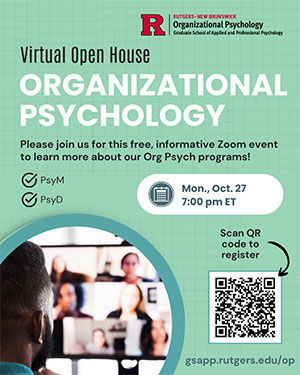
VIRTUAL OPEN HOUSE - Mon, Oct 27th 7:00 pm ET
 The Consortium for Research on Emotional Intelligence in Organizations is headquartered within the Organizational Psychology Program at Rutgers University and provides students with the unique opportunity to conduct research and collaborate with and learn from leading experts in the field of emotional intelligence. The Organizational Psychology program is currently accepting applications for our Doctoral (PsyD) and Master's (PsyM) programs for matriculation in Fall 2026. Click here or scan the QR code below to register for our virtual open house to learn more.
NEW Research Fellowship
think2perform Research Institute’s Research Fellowship program invites proposals from doctoral candidates, post-docs and junior faculty pursuing self-defined research focused on moral intelligence, purpose, and/or emotional intelligence. Click here for more information.
Listen to Consortium member Chuck Wolfe interview some of the thought leaders in emotional intelligence.
Harvard Alumni Panel - Why is interest in Emotional Intelligence Soaring?
Consortium member Chuck Wolfe hosts a panel of world class leaders in the field of emotional intelligence (EI) to talk about why interest in EI is soaring. Panel members include EI Consortium members Dr. Richard Boyatzis, Dr. Cary Cherniss and Dr. Helen Riess. Click here to view the panel discussion.
Interview with Dr. Cary Cherniss and Dr. Cornelia Roche
Host, Chuck Wolfe interviews Drs. Cary Cherniss and Cornelia Roche about their new book Leading with Feeling: Nine Strategies of Emotionally Intelligent Leadership. The authors share powerful stories of cases involving outstanding leaders using strategies that can be learned that demonstrate effective use of emotional intelligence. Click here to see the interview.
Interview with Dr. Rick Aberman
See Chuck Wolfe interview Consortium member and sports psychologist Dr. Rick Aberman on peak performance and dealing with the pandemic. The interview is filled with insights, humorous anecdotes, and strategies for achieving peak performance in athletics and in life. Click here to see the interview.
Interview with Dr. David Caruso
Chuck Wolfe interviews Consortium member David Caruso talking about their work together, the ability model of emotional intelligence, and insights into how to use emotional intelligence to address staying emotionally and mentally healthy during times of crisis and uncertainty. Click here to listen to the interview.
Interview with Dr. Richard Boyazis
How can you help someone to change? Richard Boyatzis is an expert in multiple areas including emotional intelligence. Richard and his coauthors, Melvin Smith, and Ellen Van Oosten, have discovered that helping people connect to their positive vision of themselves or an inspiring dream or goal they've long held is key to creating changes that last. In their book Helping People Change the authors share real stories and research that shows choosing a compassionate over a compliance coaching approach is a far more engaging and successful way to Helping People Change. Click here to listen to the interview.
Interview with Dr. Marc Brackett
Marc Brackett, Director of the Yale Center for Emotional Intelligence, has written a wonderful book about feelings. I worked with Marc when he was first crafting his world class social and emotional learning program, RULER. Our interview highlights how Marc has achieved his own and his Uncle's vision for encouraging each of us to understand and manage our feelings. My conversation with Marc is inspiring, humorous, and engaging at times. Click here to listen to the interview.
Interview with Dr. Helen Riess
Helen Riess is a world class expert on empathy. She is an associate clinical professor of psychiatry at Harvard Medical School and director of the Empathy and Relational Science Program at Mass General Hospital. Helen discusses her new book and shares insights, learnings and techniques such as the powerful seven-step process for understanding and increasing empathy. She relates information and cases whereby she uses empathy to make a meaningful difference in areas such as parenting and leading. Click here to listen to the interview.
Interview with Dr. Maurice Elias
The show is about the Joys and Oys of Parenting, a book written by a respected colleague, Dr. Maurice Elias, an expert in parenting and emotional and social intelligence. Dr. Elias wrote a book tying Judaism and emotional intelligence together to help parents with the challenging, compelling task of raising emotionally healthy children. And while there are fascinating links to Judaism the book is really for everybody. Click here to listen to the interview.
Interview with Geetu Bharwaney
Challenges abound and life is stressful for many. So how do we cope? Chuck Wolfe interviews Geetu Bharwaney about her book, Emotional Resilience. Geetu offers research, insights, and most importantly practical tips for helping people bounce back from adversity. Click here to listen to the interview.
Interview with Dr. Daniel Goleman
Listen to an interview by with Dr. Goleman on his new book Focus: The Hidden Driver of Excellence. In the book Dan helps readers to understand the importance and power of the ability to focus one's attention, will power, and cognitive control in creating life success. Click here to listen to the interview.
Interview with Dr. John Mayer
How Personal Intelligence Shapes Our Lives: A Conversation with John D. Mayer. From picking a life partner, to choosing a career, Jack explains how personal intelligence has a major impact on our ability to make successful decisions. Click here to listen to the interview.
Interview with Dr. Cary Cherniss
Click HERE to listen to an interview with Dr. Cary Cherniss co-chair of the EI Consortium. Dr. Cherniss discusses the issue of emotional intelligence and workplace burnout.
Interview with Dr. Marc Brackett
Click HERE to listen to an interview with Dr. Marc Brackett, the newly appointed leader of the Center of Emotional Intelligence which will begin operation at Yale University in April, 2013. In this interview Dr. Brackett shares his vision for the new center.
