- Reports
- Business Case for Emotional Intelligence
- Do Emotional Intelligence Programs Work?
- Emotional Competence Framework
- Emotional Intelligence: What it is and Why it Matters
- Executives' Emotional Intelligence (mis) Perceptions
- Guidelines for Best Practice
- Guidelines for Securing Organizational Support For EI
- Johnson & Johnson Leadership Study
- Ontario Principals’ Council Leadership Study
- Technical Report on Developing Emotional Intelligence
- Measures
- Emotional Capital Report (ECR)
- Emotional Intelligence Quotient (EQ-i)
- Emotional & Social Competence Inventory 360 (ESCI)
- Emotional & Social Competence Inventory-University (ESCI-U)
- Geneva Emotional Competence Test
- Genos Emotional Intelligence Inventory (Genos EI)
- Team Emotional Intelligence (TEI)
- Mayer Salovey Caruso Emotional Intelligence Test (MSCEIT)
- Profile of Emotional Competence (PEC)
- Schutte Self-Report Inventory (SSRI)
- Six Seconds Emotional Intelligence Assessment (SEI)
- Trait Emotional Intelligence Questionnaire (TEIQue)
- Wong's Emotional Intelligence Scale
- Work Group Emotional Intelligence Profile (WEIP)
- References
- Model Programs
- Achievement Motivation Training
- Care Giver Support Program
- Competency-Based Selection
- Emotional Competence Training - Financial Advisors
- Executive Coaching
- Human Relations Training
- Interaction Management
- Interpersonal Conflict Management - Law Enforcement
- Interpersonal Effectiveness Training - Medical Students
- JOBS Program
- LeaderLAB
- Self-Management Training to Increase Job Attendance
- Stress Management Training
- Weatherhead MBA Program
- Williams' Lifeskills Program
- Article Reprints
- Members
- Events
- Bookstore
Emotional Intelligence Training and Development
UPDATE APRIL 2015
Abe, J. A. A. (2011). Positive emotions, emotional intelligence, and successful experiential learning. Personality and Individual Differences, 51(7), 817-822. doi: http://dx.doi.org/10.1016/j.paid.2011.07.004
Ashkanasy, N. M., & Dasborough, M. T. (2003). Emotional Awareness and Emotional Intelligence in Leadership Teaching. Journal of Education for Business, 79(1), 18-22.
Boyatzis, R., McKee, A., & Goleman, D. (2002). Reawakening Your Passion for Work. Harvard Business Review, 80(4), 86-94.
Boyatzis, R. E. (2006). An overview of intentional change from a complexity perspective. Journal of Management Development, 25(7), 607-623. doi: http://dx.doi.org/10.1108/02621710610678445
Boyatzis, R. E. (2008). Leadership development from a complexity perspective. Consulting Psychology Journal: Practice and Research, 60(4), 298-313. doi: http://dx.doi.org/10.1037/1065-9293.60.4.298
Boyatzis, R. E., & Akrivou, K. (2006). The ideal self as the driver of intentional change. Journal of Management Development, 25(7), 624-642. doi: http://dx.doi.org/10.1108/02621710610678454
Boyatzis, R. E., Smith, M. L., & Blaize, N. (2006). Developing Sustainable Leaders Through Coaching and Compassion. Academy of Management Learning & Education, 5(1), 8-24.
Boyatzis, R. E., Smith, M. L., Van Oosten, E., & Woolford, L. (2013). Developing resonant leaders through emotional intelligence, vision and coaching. Organizational Dynamics, 42(1), 17-24. doi: http://dx.doi.org/10.1016/j.orgdyn.2012.12.003
Cherniss, C., Goleman, D., Emmerling, R. J., Cowan, K., & Adler, M. (1998). Bringing Emotional Intelligence to the Workplace. New Brunswick. NJ: Consortium for Research on Emotional Intelligence in Organizations: Rutgers University.
Christopher, M. S., Goerling, R. J., Rogers, B. S., Hunsinger, M., Baron, G., Bergman, A. L., & Zava, D. T. (2015). A pilot study evaluating the effectiveness of a mindfulness-based intervention on cortisol awakening response and health outcomes among law enforcement officers. Journal of Police and Criminal Psychology Jan(Pagination), No Pagination Specified. doi: http://dx.doi.org/10.1007/s11896-015-9161-x
Chun, J. U., Litzky, B. E., Sosik, J. J., Bechtold, D. C., & Godshalk, V. M. (2010). Emotional intelligence and trust in formal mentoring programs. Group & Organization Management, 35(4), 421-455. doi: http://dx.doi.org/10.1177/1059601110378293
Clarke, N. (2006). Developing emotional intelligence through workplace learning: Findings from a case study in healthcare. Human Resource Development International, 9(4), 447-465. doi: http://dx.doi.org/10.1080/13678860601032585
Clarke, N. (2006). Emotional intelligence training: A case of caveat emptor. Human Resource Development Review, 5(4), 422-441. doi: http://dx.doi.org/10.1177/1534484306293844
Clarke, N. (2010). Developing emotional intelligence abilities through team-based learning. Human Resource Development Quarterly, 21(2), 119-138. doi: http://dx.doi.org/10.1002/hrdq.20036
Clarke, N. (2010). Emotional intelligence and learning in teams. Journal of Workplace Learning, 22(3), 125-145. doi: http://dx.doi.org/10.1108/13665621011028594
Das, M. R., & Sen, A. (2021). Creating Compassionate Climates Through Leaders: An Emotional Intelligence Intervention at Indian Oil. HR Vista. https://hrvista.in/case-studies?article=39
Dong, Y., Seo, M.-G., & Bartol, K. M. (2014). No pain, no gain: An affect-based model of developmental job experience and the buffering effects of emotional intelligence. Academy of Management Journal, 57(4), 1056-1077.
Dulewicz, V., & Higgs, M. (1999). Can emotional intelligence be measured and developed? Leadership & Organization Development Journal, 20(5), 242-252. doi: http://dx.doi.org/10.1108/01437739910287117
Dulewicz, V., & Higgs, M. (2004). Can Emotional Intelligence be developed? The International Journal of Human Resource Management, 15(1), 95-111. doi: http://dx.doi.org/10.1080/0958519032000157366
Elfenbein, H. A. (2006). Learning in emotion judgments: Training and the cross-cultural understanding of facial expressions. Journal of Nonverbal Behavior, 30(1), 21-36. doi: http://dx.doi.org/10.1007/s10919-005-0002-y
Fambrough, M. J., & Hart, R. K. (2008). Emotions in leadership development: A critique of emotional intelligence. Advances in Developing Human Resources, 10(5), 740-758. doi: http://dx.doi.org/10.1177/1523422308323542
Flowers, L. K., Thomas-Squance, R., Brainin-Rodriguez, J. E., & Yancey, A. K. (2014). Interprofessional social and emotional intelligence skills training: Study findings and key lessons. Journal of Interprofessional Care, 28(2), 157-159. doi: http://dx.doi.org/10.3109/13561820.2013.847407
Gignac, G. E., Harmer, R. J., Jennings, S., & Palmer, B. R. (2012). EI training and sales performance during a corporate merger. Cross Cultural Management, 19(1), 104-116. doi: http://dx.doi.org/10.1108/13527601211195655
Gill, L. J., Ramsey, P. L., & Leberman, S. I. (2015). A systems approach to developing emotional intelligence using the self-awareness engine of growth model. Systemic Practice and Action Research Mar(Pagination), No Pagination Specified. doi: http://dx.doi.org/10.1007/s11213-015-9345-4
Gist, M. E. (1989). The influence of training method on self-efficacy and idea generation among managers. Personnel Psychology, 42(4), 787-805. doi: http://dx.doi.org/10.1111/j.1744-6570.1989.tb00675.x
Gist, M. E., Bavetta, A. G., & Stevens, C. K. (1990). Transfer training method: Its influence on skill generalization, skill repetition, and performance level. Personnel Psychology, 43(3), 501-523. doi: http://dx.doi.org/10.1111/j.1744-6570.1990.tb02394.x
Gist, M. E., Stevens, C. K., & Bavetta, A. G. (1991). Effects of self-efficacy and post-training intervention on the acquisition and maintenance of complex interpersonal skills. Personnel Psychology, 44(4), 837-861.
Grant, A. M. (2007). Enhancing coaching skills and emotional intelligence through training. [Article]. Industrial & Commercial Training, 39(5), 257-266. doi: http://dx.doi.org/10.1108/00197850710761945
Grant, L., Kinman, G., & Alexander, K. (2014). What's all this talk about emotion? Developing emotional intelligence in social work students. Social Work Education, 33(7), 874-889. doi: http://dx.doi.org/10.1080/02615479.2014.891012
Groves, K. S., McEnrue, M. P., & Shen, W. (2008). Developing and measuring the emotional intelligence of leaders. Journal of Management Development, 27(2), 225-250. doi: http://dx.doi.org/10.1108/02621710810849353
Hen, M., & Goroshit, M. (2011). Emotional competencies in the education of mental health professionals. Social Work Education, 30(7), 811-829. doi: http://dx.doi.org/10.1080/02615479.2010.515680
Henochowicz, S., & Hetherington, D. (2006). Leadership coaching in health care. Leadership & Organization Development Journal, 27(3), 183-189. doi: http://dx.doi.org/10.1108/01437730610657703
Hong, R. Y., Triyono, W., & Ong, P. S. (2013). When being discrepant from one's ideal or ought selves hurts: The moderating role of neuroticism. European Journal of Personality, 27(3), 256-270. doi: http://dx.doi.org/10.1002/per.1888
Horton-Deutsch, S., & Sherwood, G. (2008). Reflection: An educational strategy to develop emotionally-competent nurse leaders. Journal of Nursing Management, 16(8), 946-954. doi: http://dx.doi.org/10.1111/j.1365-2834.2008.00957.x
Jamali, D., Sidani, Y., & Abu-Zaki, D. (2008). Emotional intelligence and management development implications: Insights from the Lebanese context. Journal of Management Development, 27(3), 348-360.
Kirk, B. A., Schutte, N. S., & Hine, D. W. (2011). The effect of an expressive-writing intervention for employees on emotional self-efficacy, emotional intelligence, affect, and workplace incivility. Journal of Applied Social Psychology, 41(1), 179-195. doi: http://dx.doi.org/10.1111/j.1559-1816.2010.00708.x
Kotsou, I., Nelis, D., Gregoire, J., & Mikolajczak, M. (2011). Emotional plasticity: Conditions and effects of improving emotional competence in adulthood. Journal of Applied Psychology, 96(4), 827-839. doi: http://dx.doi.org/10.1037/a0023047
Kruml, S. M., & Yockey, M. D. (2011). Developing the emotionally intelligent leader: Instructional issues. Journal of Leadership & Organizational Studies, 18(2), 207-215. doi: http://dx.doi.org/10.1177/1548051810372220
Larin, H. M., Benson, G., Martin, L., Wessel, J., Williams, R., & Ploeg, J. (2011). Examining change in emotional-social intelligence, caring, and leadership in health professions students. Journal of Allied Health, 40(2), 96-102.
Latham, G. P., & Frayne, C. A. (1989). Self-management training for increasing job attendance: A follow-up and a replication. Journal of Applied Psychology, 74(3), 411-416. doi: http://dx.doi.org/10.1037/0021-9010.74.3.411
Latham, G. P., & Saari, L. M. (1979). Application of social-learning theory to training supervisors through behavioral modeling. Journal of Applied Psychology, 64(3), 239-246. doi: http://dx.doi.org/10.1037/0021-9010.64.3.239
Leonard, D. C. (2008). The impact of learning goals on emotional, social, and cognitive intelligence competency development. Journal of Management Development, 27(1), 109-128. doi: http://dx.doi.org/10.1108/02621710810840794
Lindebaum, D. (2009). Rhetoric or remedy? A critique on developing emotional intelligence. Academy of Management Learning & Education, 8(2), 225-237.
Lomas, T., Edginton, T., Cartwright, T., & Ridge, D. (2013). Men Developing Emotional Intelligence Through Meditation? Integrating Narrative, Cognitive and Electroencephalography (EEG) Evidence. Psychology of Men & Masculinity Jun(Pagination), No Pagination Specified. doi: http://dx.doi.org/10.1037/a0032191
Lomas, T., Edginton, T., Cartwright, T., & Ridge, D. (2014). Men developing emotional intelligence through meditation? Integrating narrative, cognitive and electroencephalography (EEG) evidence. Psychology of Men & Masculinity, 15(2), 213-224. doi: http://dx.doi.org/10.1037/a0032191
Mainemelis, C., Boyatzis, R. E., & Kolb, D. A. (2002). Learning styles and adaptive flexibility: Testing experiential learning theory. Management Learning, 33(1), 5-33. doi: http://dx.doi.org/10.1177/1350507602331001
Manring, S. L. (2012). Tapping and fostering students' emotional intelligence through service-learning experiences. Journal of Behavioral and Applied Management, 13(3), 168-185.
Marx, R. D. (1982). Relapse Prevention for Managerial Training: A Model for Maintenance of Behavior Change. [Article]. Academy of Management Review, 7(3), 433-441. doi: http://dx.doi.org/10.5465/amr.1982.4285359
McEnrue, M. P., Groves, K. S., & Shen, W. (2009). Emotional intelligence development: Leveraging individual characteristics. Journal of Management Development, 28(2), 150-174. doi: http://dx.doi.org/10.1108/02621710910932106
Muyia, H. M., & Kacirek, K. (2009). An empirical study of a leadership development training program and its impact on emotional intelligence quotient (EQ) scores. Advances in Developing Human Resources, 11(6), 703-718. doi: http://dx.doi.org/10.1177/1523422309360844
Myers, L. L., & Tucker, M. L. (2005). Increasing awareness of emotional intelligence in a business curriculum. [Article]. Business Communication Quarterly, 68(1), 44-51. doi: http://dx.doi.org/10.1177/1080569904273753
Nel, J. A., Jonker, C. S., & Rabie, T. (2013). Emotional intelligence and wellness among employees working in the nursing environment. Journal of Psychology in Africa, 23(2), 195-204.
Nelis, D., Kotsou, I., Quoidbach, J., Hansenne, M., Weytens, F., Dupuis, P., & Mikolajczak, M. (2011). Increasing emotional competence improves psychological and physical well-being, social relationships, and employability. Emotion, 11(2), 354-366. doi: http://dx.doi.org/10.1037/a0021554
Nelis, D., Quoidbach, J., Mikolajczak, M., & Hansenne, M. (2009). Increasing emotional intelligence: (How) is it possible? Personality and Individual Differences, 47(1), 36-41. doi: http://dx.doi.org/10.1016/j.paid.2009.01.046
Noe, R. A. (1986). Trainees' Attributes and Attitudes: Neglected Influences on Training Effectiveness. Academy of Management Review, 11(4), 736-749. doi: http://dx.doi.org/10.5465/amr.1986.4283922
Passarelli, A. (2014). Harnessing the power of a massive open online course (MOOC): Inspiring leadership through emotional intelligence. Academy of Management Learning & Education, 13(2), 298-300. doi: http://dx.doi.org/10.5465/amle.2014.0083
Porras, J. I., & Anderson, B. (1981). Improving Managerial Effectiveness Through Modeling-Based Training. [Article]. Organizational Dynamics, 9(4), 60-77.
Porras, J. I., & Hargis, K. (1982). Precursors of individual change: Responses to a social learning theory based on organizational intervention. Human Relations, 35(11), 973-990. doi: http://dx.doi.org/10.1177/001872678203501103
Reilly, P. (2005). Teaching Law Students How to Feel: Using Negotiations Training to Increase Emotional Intelligence. Negotiation Journal, 21(2), 301-314. doi: http://dx.doi.org/10.1111/j.1571-9979.2005.00065.x
Roberts, R. D., MacCann, C., Matthews, G., & Zeidner, M. (2010). Teaching and learning guide for: Emotional intelligence: Towards a consensus of models and measures. Social and Personality Psychology Compass, 4(10), 968-981. doi: http://dx.doi.org/10.1111/j.1751-9004.2010.00310.x
Sadri, G. (2012). Emotional intelligence and leadership development. Public Personnel Management, 41(3), 535-548. doi: http://dx.doi.org/10.1177/009102601204100308
Sheldon, O. J., Dunning, D., & Ames, D. R. (2013). Emotionally Unskilled, Unaware, and Uninterested in Learning More: Reactions to Feedback About Deficits in Emotional Intelligence. Journal of Applied Psychology Aug(Pagination), No Pagination Specified. doi: http://dx.doi.org/10.1037/a0034138
Sheldon, O. J., Dunning, D., & Ames, D. R. (2014). Emotionally unskilled, unaware, and uninterested in learning more: Reactions to feedback about deficits in emotional intelligence. Journal of Applied Psychology, 99(1), 125-137. doi: http://dx.doi.org/10.1037/a0034138
Slaski, M., & Cartwright, S. (2003). Emotional intelligence training and its implications for stress, health and performance. Stress and Health: Journal of the International Society for the Investigation of Stress, 19(4), 233-239. doi: http://dx.doi.org/10.1002/smi.979
Song, E., Oh, E., & Choi, Y. (2014). Effects of teaching communication skills using a video clip on a smart phone on communication competence and emotional intelligence in nursing students. Archives of Psychiatric Nursing Nov(Pagination), No Pagination Specified. doi: http://dx.doi.org/10.1016/j.apnu.2014.11.003
Stevens, C. K., & Gist, M. E. (1997). Effects of self-efficacy and goal-orientation training on negotiation skill maintenance: What are the mechanisms? Personnel Psychology, 50(4), 955-978. doi: http://dx.doi.org/10.1111/j.1744-6570.1997.tb01490.x
Stratton, T. D., Saunders, J. A., & Elam, C. L. (2008). Changes in medical students' emotional intelligence: An exploratory study. Teaching and Learning in Medicine, 20(3), 279-284.
Thory, K. (2013). A gendered analysis of emotional intelligence in the workplace: Issues and concerns for human resource development. Human Resource Development Review, 12(2), 221-244. doi: http://dx.doi.org/10.1177/1534484312469100
Thory, K. (2013). Teaching managers to regulate their emotions better: Insights from emotional intelligence training and work-based application. Human Resource Development International, 16(1), 4-21. doi: http://dx.doi.org/10.1080/13678868.2012.738473
Vesely, A. K., Saklofske, D. H., & Nordstokke, D. W. (2014). EI training and pre-service teacher wellbeing. Personality and Individual Differences, 65, 81-85. doi: http://dx.doi.org/10.1016/j.paid.2014.01.052
Watkin, C. (2000). Developing emotional intelligence. International Journal of Selection and Assessment, 8(2), 89-92. doi: http://dx.doi.org/10.1111/1468-2389.00137
Weinberger, L. A. (2002). Emotional Intelligence: Its Connection to HRD Theory and Practice. Human Resource Development Review, 1(2), 215-243. doi: http://dx.doi.org/10.1177/15384302001002005
Yuan, B. J., Hsu, W.-L., Shieh, J.-H., & Li, K.-P. (2012). Increasing emotional intelligence of employees: Evidence from research and development teams in Taiwan. Social Behavior and Personality, 40(10), 1713-1724. doi: http://dx.doi.org/10.2224/sbp.2012.40.10.1713
Zijlmans, L., Embregts, P., Gerits, L., Bosman, A., & Derksen, J. (2014). The effectiveness of staff training focused on increasing emotional intelligence and improving interaction between support staff and clients. Journal of Intellectual Disability Research Aug(Pagination), No Pagination Specified. doi: http://dx.doi.org/10.1111/jir.12164

News and Events
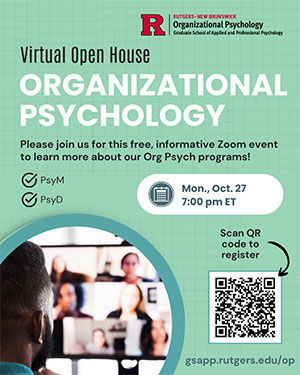
VIRTUAL OPEN HOUSE - Mon, Oct 27th 7:00 pm ET
 The Consortium for Research on Emotional Intelligence in Organizations is headquartered within the Organizational Psychology Program at Rutgers University and provides students with the unique opportunity to conduct research and collaborate with and learn from leading experts in the field of emotional intelligence. The Organizational Psychology program is currently accepting applications for our Doctoral (PsyD) and Master's (PsyM) programs for matriculation in Fall 2026. Click here or scan the QR code below to register for our virtual open house to learn more.
NEW Research Fellowship
think2perform Research Institute’s Research Fellowship program invites proposals from doctoral candidates, post-docs and junior faculty pursuing self-defined research focused on moral intelligence, purpose, and/or emotional intelligence. Click here for more information.
Listen to Consortium member Chuck Wolfe interview some of the thought leaders in emotional intelligence.
Harvard Alumni Panel - Why is interest in Emotional Intelligence Soaring?
Consortium member Chuck Wolfe hosts a panel of world class leaders in the field of emotional intelligence (EI) to talk about why interest in EI is soaring. Panel members include EI Consortium members Dr. Richard Boyatzis, Dr. Cary Cherniss and Dr. Helen Riess. Click here to view the panel discussion.
Interview with Dr. Cary Cherniss and Dr. Cornelia Roche
Host, Chuck Wolfe interviews Drs. Cary Cherniss and Cornelia Roche about their new book Leading with Feeling: Nine Strategies of Emotionally Intelligent Leadership. The authors share powerful stories of cases involving outstanding leaders using strategies that can be learned that demonstrate effective use of emotional intelligence. Click here to see the interview.
Interview with Dr. Rick Aberman
See Chuck Wolfe interview Consortium member and sports psychologist Dr. Rick Aberman on peak performance and dealing with the pandemic. The interview is filled with insights, humorous anecdotes, and strategies for achieving peak performance in athletics and in life. Click here to see the interview.
Interview with Dr. David Caruso
Chuck Wolfe interviews Consortium member David Caruso talking about their work together, the ability model of emotional intelligence, and insights into how to use emotional intelligence to address staying emotionally and mentally healthy during times of crisis and uncertainty. Click here to listen to the interview.
Interview with Dr. Richard Boyazis
How can you help someone to change? Richard Boyatzis is an expert in multiple areas including emotional intelligence. Richard and his coauthors, Melvin Smith, and Ellen Van Oosten, have discovered that helping people connect to their positive vision of themselves or an inspiring dream or goal they've long held is key to creating changes that last. In their book Helping People Change the authors share real stories and research that shows choosing a compassionate over a compliance coaching approach is a far more engaging and successful way to Helping People Change. Click here to listen to the interview.
Interview with Dr. Marc Brackett
Marc Brackett, Director of the Yale Center for Emotional Intelligence, has written a wonderful book about feelings. I worked with Marc when he was first crafting his world class social and emotional learning program, RULER. Our interview highlights how Marc has achieved his own and his Uncle's vision for encouraging each of us to understand and manage our feelings. My conversation with Marc is inspiring, humorous, and engaging at times. Click here to listen to the interview.
Interview with Dr. Helen Riess
Helen Riess is a world class expert on empathy. She is an associate clinical professor of psychiatry at Harvard Medical School and director of the Empathy and Relational Science Program at Mass General Hospital. Helen discusses her new book and shares insights, learnings and techniques such as the powerful seven-step process for understanding and increasing empathy. She relates information and cases whereby she uses empathy to make a meaningful difference in areas such as parenting and leading. Click here to listen to the interview.
Interview with Dr. Maurice Elias
The show is about the Joys and Oys of Parenting, a book written by a respected colleague, Dr. Maurice Elias, an expert in parenting and emotional and social intelligence. Dr. Elias wrote a book tying Judaism and emotional intelligence together to help parents with the challenging, compelling task of raising emotionally healthy children. And while there are fascinating links to Judaism the book is really for everybody. Click here to listen to the interview.
Interview with Geetu Bharwaney
Challenges abound and life is stressful for many. So how do we cope? Chuck Wolfe interviews Geetu Bharwaney about her book, Emotional Resilience. Geetu offers research, insights, and most importantly practical tips for helping people bounce back from adversity. Click here to listen to the interview.
Interview with Dr. Daniel Goleman
Listen to an interview by with Dr. Goleman on his new book Focus: The Hidden Driver of Excellence. In the book Dan helps readers to understand the importance and power of the ability to focus one's attention, will power, and cognitive control in creating life success. Click here to listen to the interview.
Interview with Dr. John Mayer
How Personal Intelligence Shapes Our Lives: A Conversation with John D. Mayer. From picking a life partner, to choosing a career, Jack explains how personal intelligence has a major impact on our ability to make successful decisions. Click here to listen to the interview.
Interview with Dr. Cary Cherniss
Click HERE to listen to an interview with Dr. Cary Cherniss co-chair of the EI Consortium. Dr. Cherniss discusses the issue of emotional intelligence and workplace burnout.
Interview with Dr. Marc Brackett
Click HERE to listen to an interview with Dr. Marc Brackett, the newly appointed leader of the Center of Emotional Intelligence which will begin operation at Yale University in April, 2013. In this interview Dr. Brackett shares his vision for the new center.
