
- Reports
- Business Case for Emotional Intelligence
- Do Emotional Intelligence Programs Work?
- Emotional Competence Framework
- Emotional Intelligence: What it is and Why it Matters
- Executives' Emotional Intelligence (mis) Perceptions
- Guidelines for Best Practice
- Guidelines for Securing Organizational Support For EI
- Johnson & Johnson Leadership Study
- Ontario Principals’ Council Leadership Study
- Technical Report on Developing Emotional Intelligence
- Measures
- Emotional Capital Report (ECR)
- Emotional Intelligence Quotient (EQ-i)
- Emotional & Social Competence Inventory 360 (ESCI)
- Emotional & Social Competence Inventory-University (ESCI-U)
- Geneva Emotional Competence Test
- Genos Emotional Intelligence Inventory (Genos EI)
- Team Emotional Intelligence (TEI)
- Mayer Salovey Caruso Emotional Intelligence Test (MSCEIT)
- Profile of Emotional Competence (PEC)
- Schutte Self-Report Inventory (SSRI)
- Six Seconds Emotional Intelligence Assessment (SEI)
- Trait Emotional Intelligence Questionnaire (TEIQue)
- Wong's Emotional Intelligence Scale
- Work Group Emotional Intelligence Profile (WEIP)
- References
- Model Programs
- Achievement Motivation Training
- Care Giver Support Program
- Competency-Based Selection
- Emotional Competence Training - Financial Advisors
- Executive Coaching
- Human Relations Training
- Interaction Management
- Interpersonal Conflict Management - Law Enforcement
- Interpersonal Effectiveness Training - Medical Students
- JOBS Program
- LeaderLAB
- Self-Management Training to Increase Job Attendance
- Stress Management Training
- Weatherhead MBA Program
- Williams' Lifeskills Program
- Article Reprints
- Members
- Events
- Bookstore
Emotional Intelligence - Psychometric Issues
UPDATED APRIL 2015
Allen, V., Rahman, N., Weissman, A., MacCann, C., Lewis, C., & Roberts, R. D. (2015). The situational test of emotional management - brief (stem-b): Development and validation using item response theory and latent class analysis. Personality and Individual Differences Feb(Pagination), No Pagination Specified.
Andrei, F., Mancini, G., Baldaro, B., Trombini, E., & Agnoli, S. (2014). A systematic review on the Predictive Utility of the Trait Emotional Intelligence Questionnaire (TEIQue). Bollettino di Psicologia Applicata, 271(62), 2-29.
Anguiano-Carrasco, C., MacCann, C., Geiger, M., Seybert, J. M., & Roberts, R. D. (2015). Development of a forced-choice measure of typical-performance emotional intelligence. Journal of Psychoeducational Assessment, 33(1), 83-97.
Apaydin, C., & Anafarta, A. (2012). Factorial validation of the Seven-Component Model of the Work Profile Questionnaire Emotional Intelligence (WPQei) in a Turkish educational setting. Journal of Instructional Psychology, 39(3-4), 159-170.
Austin, E. J., Saklofske, D. H., Huang, S. H., & McKenney, D. (2004). Measurement of trait emotional intelligence: Testing and cross-validating a modified version of Schutte et al.'s (1998) measure. Personality and Individual Differences, 36(3), 555-562. doi: http://dx.doi.org/10.1016/S0191-8869%2803%2900114-4
Barchard, K. A., & Christensen, M. M. (2007). Dimensionality and higher-order factor structure of self-reported emotional intelligence. Personality and Individual Differences, 42(6), 971-985. doi: http://dx.doi.org/10.1016/j.paid.2006.09.007
Barraca, J., Fernandez-Gonzalez, A., Opazo, H., & Lozano-Bleda, J. H. (2012). MSCEIT & TESIS: Relationships between two ability-based Emotional Intelligence tests. Ansiedad y Estres, 18(2-3), 187-200.
Batista-Foguet, J. M., Saris, W., Boyatzis, R., Guillen, L., & Serlavos, R. (2009). Effect of response scale on assessment of emotional intelligence competencies. Personality and Individual Differences, 46(5-6), 575-580. doi: http://dx.doi.org/10.1016/j.paid.2008.12.011
Bester, M., Jonker, C. S., & Nel, J. A. (2013). Confirming the factor structure of the 41-item version of the Schutte Emotional Intelligence Scale. Journal of Psychology in Africa, 23(2), 213-222.
Blickle, G., Momm, T., Liu, Y., Witzki, A., & Steinmayr, R. (2011). Construct validation of the Test of Emotional Intelligence (TEMINT): A two-study investigation. European Journal of Psychological Assessment, 27(4), 282-289. doi: http://dx.doi.org/10.1027/1015-5759/a000075
Booth, T., & Hughes, D. J. (2014). Exploratory structural equation modeling of personality data. Assessment, 21(3), 260-271. doi: http://dx.doi.org/10.1177/1073191114528029
Brackett, M. A., & Mayer, J. D. (2003). Convergent, Discriminant, and Incremental Validity of Competing Measures of Emotional Intelligence. Personality and Social Psychology Bulletin, 29(9), 1147-1158. doi: http://dx.doi.org/10.1177/0146167203254596
Brackett, M. A., Rivers, S. E., Shiffman, S., Lerner, N., & Salovey, P. (2006). Relating emotional abilities to social functioning: A comparison of self-report and performance measures of emotional intelligence. Journal of Personality and Social Psychology, 91(4), 780-795. doi: http://dx.doi.org/10.1037/0022-3514.91.4.780
Brackett, M. A., & Salovey, P. (2006). Measuring emotional intelligence with the Mayer-Salovery-Caruso Emotional Intelligence Test (MSCEIT). Psicothema, 18(Suppl), 34-41.
Brannick, M. T., Wahi, M. M., Arce, M., Johnson, H.-A., Nazian, S., & Goldin, S. B. (2009). Comparison of trait and ability measures of emotional intelligence in medical students. Medical Education, 43(11), 1062-1068. doi: http://dx.doi.org/10.1111/j.1365-2923.2009.03430.x
Burrus, J., Betancourt, A., Holtzman, S., Minsky, J., MacCann, C., & Roberts, R. D. (2012). Emotional intelligence relates to well-being: Evidence from the Situational Judgment Test of Emotional Management. Applied Psychology: Health and Well-Being, 4(2), 151-166.
Byrne, J. C., Dominick, P. G., Smither, J. W., & Reilly, R. R. (2007). Examination of the discriminant, convergent, and criterion-related validity of self-ratings on the Emotional Competence Inventory. International Journal of Selection and Assessment, 15(3), 341-353. doi: http://dx.doi.org/10.1111/j.1468-2389.2007.00393.x
Cartwright, S., & Pappas, C. (2008). Emotional intelligence, its measurement and implications for the workplace. International Journal of Management Reviews, 10(2), 149-171.
Chapman, B. P., & Hayslip, B., Jr. (2005). Incremental Validity of a Measure of Emotional Intelligence. Journal of Personality Assessment, 85(2), 154-169. doi: http://dx.doi.org/10.1207/s15327752jpa8502_08
Choi, S., Kluemper, D. H., & Sauley, K. S. (2011). What if we fake emotional intelligence? A test of criterion validity attenuation. Journal of Personality Assessment, 93(3), 270-277. doi: http://dx.doi.org/10.1080/00223891.2011.558870
Christiansen, N. D., Janovics, J. E., & Siers, B. P. (2010). Emotional intelligence in selection contexts: Measurement method, criterion-related validity, and vulnerability to response distortion. International Journal of Selection and Assessment, 18(1), 87-101. doi: http://dx.doi.org/10.1111/j.1468-2389.2010.00491.x
Ciarrochi, J., Caputi, P., & Mayer, J. D. (2003). The distinctiveness and utility of a measure of trait emotional awareness. Personality and Individual Differences, 34(8), 1477-1490. doi: http://dx.doi.org/10.1016/S0191-8869%2802%2900129-0
Conte, J. M. (2005). A review and critique of emotional intelligence measures. Journal of Organizational Behavior, 26(4), 433-440. doi: http://dx.doi.org/10.1002/job.319
Cooper, A., & Petrides, K. (2010). A psychometric analysis of the Trait Emotional Intelligence Questionnaire-Short Form (TEIQue-SF) using item response theory. Journal of Personality Assessment, 92(5), 449-457. doi: http://dx.doi.org/10.1080/00223891.2010.497426
Costa, A. C. F., & Faria, L. M. S. (2014). Assessment of emotional intelligence: The relation of ability-based and self- report measures. Psicologia: Teoria e Pesquisa, 30(3), 339-346. doi: http://dx.doi.org/10.1590/S0102-37722014000300011
Cote, S., & Miners, C. T. (2006). Emotional Intelligence, Cognitive Intelligence, and Job Performance. Administrative Science Quarterly, 51(1), 1-28. doi: http://dx.doi.org/10.2189/asqu.51.1.1
Craparo, G., Magnano, P., & Faraci, P. (2014). Psychometric properties of the Italian version of the Self-Report Emotional Intelligence Test (SREIT). TPM-Testing, Psychometrics, Methodology in Applied Psychology, 21(2), 121-133.
Curci, A., Lanciano, T., Soleti, E., Zammuner, V. L., & Salovey, P. (2013). Construct validity of the Italian version of the Mayer-Salovey-Caruso Emotional Intelligence Test (MSCEIT) v2.0. Journal of Personality Assessment, 95(5), 486-494. doi: http://dx.doi.org/10.1080/00223891.2013.778272
Davies, K. A., Lane, A. M., Devonport, T. J., & Scott, J. A. (2010). Validity and reliability of a Brief Emotional Intelligence Scale (BEIS-10). Journal of Individual Differences, 31(4), 198-208. doi: http://dx.doi.org/10.1027/1614-0001/a000028
Day, A. L., & Carroll, S. A. (2008). Faking emotional intelligence (EI): Comparing response distortion on ability and trait-based EI measures. Journal of Organizational Behavior, 29(6), 761-784. doi: http://dx.doi.org/10.1002/job.485
Dulewicz, V., & Higgs, M. (1999). Can emotional intelligence be measured and developed? Leadership & Organization Development Journal, 20(5), 242-252. doi: http://dx.doi.org/10.1108/01437739910287117
Dulewicz, V., Higgs, M., & Slaski, M. (2003). Measuring emotional intelligence: Content, construct and criterion-related validity. Journal of Managerial Psychology, 18(5), 405-420. doi: http://dx.doi.org/10.1108/02683940310484017
Elfenbein, H. A., Barsade, S. G., & Eisenkraft, N. (2015). The social perception of emotional abilities: Expanding what we know about observer ratings of emotional intelligence. Emotion, 15(1), 17-34. doi: http://dx.doi.org/10.1037/a0038436
Extremera, N., Fernandez-Berrocal, P., & Salovey, P. (2006). Spanish version of the Mayer-Salovey-Caruso Emotional Intelligence Test (MSCEIT). Version 2.0: Reliabilities, age and gender differences. Psicothema, 18(Suppl), 42-48.
Fan, H., Jackson, T., Yang, X., Tang, W., & Zhang, J. (2010). The factor structure of the Mayer-Salovey-Caruso emotional intelligence test V 2.0 (MSCEIT): A meta-analytic structural equation modeling approach. Personality and Individual Differences, 48(7), 781-785. doi: http://dx.doi.org/10.1016/j.paid.2010.02.004
Faria, L., & Santos, N. L. (2009). Validation of the Emotional Skills and Competence Questionnaire (ESCQ) in the Portuguese academic context. Psiholoska Obzorja/Horizons of Psychology, 18(3), 55-71.
Fernandez-Berrocal, P., Cabello, R., Castillo, R., & Extremera, N. (2012). Gender differences in emotional intelligence: The mediating effect of age. Behavioral Psychology / Psicologia Conductual: Revista Internacional Clinica y de la Salud, 20(1), 77-89.
Fiori, M., & Antonakis, J. (2011). The ability model of emotional intelligence: Searching for valid measures. Personality and Individual Differences, 50(3), 329-334. doi: http://dx.doi.org/10.1016/j.paid.2010.10.010
Follesdal, H., & Hagtvet, K. A. (2009). Emotional intelligence: The MSCEIT from the perspective of generalizability theory. Intelligence, 37(1), 94-105. doi: http://dx.doi.org/10.1016/j.intell.2008.08.005
Fox, S., & Spector, P. E. (2000). Relations of emotional intelligence, practical intelligence, general intelligence, and trait affectivity with interview outcomes: It's not all just 'G'. Journal of Organizational Behavior, 21(Spec Issue), 203-220. doi: http://dx.doi.org/10.1002/%28SICI%291099-1379%28200003%2921:2%3C203::AID-JOB38%3E3.0.CO;2-Z
Freudenthaler, H., Neubauer, A. C., Gabler, P., Scherl, W. G., & Rindermann, H. (2008). Testing and validating the Trait Emotional Intelligence Questionnaire (TEIQue) in a German-speaking sample. Personality and Individual Differences, 45(7), 673-678. doi: http://dx.doi.org/10.1016/j.paid.2008.07.014
Freudenthaler, H. H., & Neubauer, A. C. (2005). Emotional intelligence: The convergent and discriminant validities of intra- and interpersonal emotional abilities. Personality and Individual Differences, 39(3), 569-579. doi: http://dx.doi.org/10.1016/j.paid.2005.02.004
Fukuda, E., Saklofske, D. H., Tamaoka, K., & Lim, H. (2012). Factor structure of the Korean version of Wong and Law's Emotional Intelligence Scale. Assessment, 19(1), 3-7. doi: http://dx.doi.org/10.1177/1073191111428863
Furnham, A. (2009). Sex, IQ, and emotional intelligence. Psychological Reports, 105(3, Pt2), 1092-1094.
Furnham, A., Arteche, A., Chamorro-Premuzic, T., Keser, A., & Swami, V. (2009). Self- and other-estimates of multiple abilities in Britain and Turkey: A cross-cultural comparison of subjective ratings of intelligence. International Journal of Psychology, 44(6), 434-442. doi: http://dx.doi.org/10.1080/00207590802644766
Ghorbani, N., Bing, M. N., Watson, P. J., Davison, H. K., & Mack, D. A. (2002). Self-reported emotional intelligence: Construct similarity and functional dissimilarity of higher-order processing in Iran and the United States. [Article]. International Journal of Psychology, 37(5), 297-308. doi: http://dx.doi.org/10.1080/00207590244000098
Gignac, G. (2010). Seven-factor model of emotional intelligence as measured by Genos EI: A confirmatory factor analytic investigation based on self- and rater-report data. European Journal of Psychological Assessment, 26(4), 309-316. doi: http://dx.doi.org/10.1027/1015-5759/a000041
Gignac, G. E. (2005). Evaluating the MSCEIT V2.0 via CFA: Comment on Mayer et al. (2003). [Comment/Reply]. Emotion, 5(2), 233-235. doi: http://dx.doi.org/10.1037/1528-3542.5.2.233
Gignac, G. E., Palmer, B. R., Manocha, R., & Stough, C. (2005). An examination of the factor structure of the schutte self-report emotional intelligence (SSREI) scale via confirmatory factor analysis. Personality and Individual Differences, 39(6), 1029-1042. doi: http://dx.doi.org/10.1016/j.paid.2005.03.014
Goldenberg, I., Matheson, K., & Mantler, J. (2006). The Assessment of Emotional Intelligence: A Comparison of Performance-Based and Self-Report Methodologies. [Article]. Journal of Personality Assessment, 86(1), 33-45. doi: http://dx.doi.org/10.1207/s15327752jpa8601_05
Groves, K. S., McEnrue, M. P., & Shen, W. (2008). Developing and measuring the emotional intelligence of leaders. Journal of Management Development, 27(2), 225-250. doi: http://dx.doi.org/10.1108/02621710810849353
Grubb, W., & McDaniel, M. A. (2007). The Fakability of Bar-On's Emotional Quotient Inventory Short Form: Catch Me if You Can. Human Performance, 20(1), 43-59. doi: http://dx.doi.org/10.1207/s15327043hup2001_3
Hartman, N. S., & Grubb, W. (2011). Deliberate faking on personality and emotional intelligence measures. Psychological Reports, 108(1), 120-138. doi: http://dx.doi.org/10.2466/03.09.28.PR0.108.1.120-138
Iliescu, D., Ilie, A., Ispas, D., & Ion, A. (2012). Emotional intelligence in personnel selection: Applicant reactions, criterion, and incremental validity. International Journal of Selection and Assessment, 20(3), 347-358. doi: http://dx.doi.org/10.1111/j.1468-2389.2012.00605.x
Iliescu, D., Ilie, A., Ispas, D., & Ion, A. (2013). Examining the psychometric properties of the Mayer-Salovey-Caruso Emotional Intelligence Test: Findings from an Eastern European culture. European Journal of Psychological Assessment, 29(2), 121-128. doi: http://dx.doi.org/10.1027/1015-5759/a000132
Jordan, P. J., & Lawrence, S. A. (2009). Emotional intelligence in teams: Development and initial validation of the short version of the Workgroup Emotional Intelligence Profile (WEIP-S). Journal of Management & Organization, 15(4), 452-469. doi: http://dx.doi.org/10.5172/jmo.15.4.452
Joseph, D. L., & Newman, D. A. (2010). Discriminant validity of self-reported emotional intelligence: A multitrait-multisource study. Educational and Psychological Measurement, 70(4), 672-694. doi: http://dx.doi.org/10.1177/0013164409355700
Karim, J., & Weisz, R. (2010). Cross-cultural research on the reliability and validity of the Mayer-Salovey-Caruso Emotional Intelligence Test (MSCEIT). Cross-Cultural Research: The Journal of Comparative Social Science, 44(4), 374-404. doi: http://dx.doi.org/10.1177/1069397110377603
Keefer, K. V. (2015). Self-report assessments of emotional competencies: A critical look at methods and meanings. Journal of Psychoeducational Assessment, 33(1), 3-23.
Keele, S. M., & Bell, R. C. (2008). The factorial validity of emotional intelligence: An unresolved issue. Personality and Individual Differences, 44(2), 487-500. doi: http://dx.doi.org/10.1016/j.paid.2007.09.013
Kong, D. T. (2014). Mayer-Salovey-Caruso Emotional Intelligence Test (MSCEIT/MEIS) and overall, verbal, and nonverbal intelligence: Meta-analytic evidence and critical contingencies. Personality and Individual Differences, 66, 171-175. doi: http://dx.doi.org/10.1016/j.paid.2014.03.028
Law, K. S., Wong, C.-S., & Song, L. J. (2004). The Construct and Criterion Validity of Emotional Intelligence and Its Potential Utility for Management Studies. Journal of Applied Psychology, 89(3), 483-496. doi: http://dx.doi.org/10.1037/0021-9010.89.3.483
Libbrecht, N., De Beuckelaer, A., Lievens, F., & Rockstuhl, T. (2014). Measurement invariance of the Wong and Law Emotional Intelligence Scale scores: Does the measurement structure hold across Far Eastern and European countries? Applied Psychology: An International Review, 63(2), 223-237. doi: http://dx.doi.org/10.1111/j.1464-0597.2012.00513.x
Libbrecht, N., & Lievens, F. (2012). Validity evidence for the situational judgment test paradigm in emotional intelligence measurement. International Journal of Psychology, 47(6), 438-447. doi: http://dx.doi.org/10.1080/00207594.2012.682063
Libbrecht, N., Lievens, F., & Schollaert, E. (2010). Measurement equivalence of the Wong and Law Emotional Intelligence Scale across self and other ratings. Educational and Psychological Measurement, 70(6), 1007-1020. doi: http://dx.doi.org/10.1177/0013164410378090
Lievens, F., Klehe, U.-C., & Libbrecht, N. (2011). Applicant versus employee scores on self-report emotional intelligence measures. Journal of Personnel Psychology, 10(2), 89-95. doi: http://dx.doi.org/10.1027/1866-5888/a000036
Livingstone, H. A., & Day, A. L. (2005). Comparing the Construct and Criterion-Related Validity of Ability-Based and Mixed-Model Measures of Emotional Intelligence. Educational and Psychological Measurement, 65(5), 757-779. doi: http://dx.doi.org/10.1177/0013164405275663
Lopez-Zafra, E., & Gartzia, L. (2014). Perceptions of gender differences in self-report measures of emotional intelligence. Sex Roles, 70(11-12), 479-495. doi: http://dx.doi.org/10.1007/s11199-014-0368-6
MacCann, C., Joseph, D. L., Newman, D. A., & Roberts, R. D. (2014). Emotional intelligence is a second-stratum factor of intelligence: Evidence from hierarchical and bifactor models. Emotion, 14(2), 358-374. doi: http://dx.doi.org/10.1037/a0034755
MacCann, C., Matthews, G., Zeidner, M., & Roberts, R. D. (2003). Psychological Assessment of Emotional Intelligence: A Review of Self-Report and Performance-Based Testing. The International Journal of Organizational Analysis, 11(3), 247-274. doi: http://dx.doi.org/10.1108/eb028975
MacCann, C., & Roberts, R. D. (2008). New paradigms for assessing emotional intelligence: Theory and data. Emotion, 8(4), 540-551. doi: http://dx.doi.org/10.1037/a0012746
MacCann, C., Roberts, R. D., Matthews, G., & Zeidner, M. (2004). Consensus scoring and empirical option weighting of performance-based Emotional Intelligence (El) tests. Personality and Individual Differences, 36(3), 645-662. doi: http://dx.doi.org/10.1016/S0191-8869%2803%2900123-5
Martskvishvili, K., Arutinov, L., & Mestvirishvili, M. (2013). A psychometric investigation of the Georgian version of the Trait Emotional Intelligence Questionnaire. European Journal of Psychological Assessment, 29(2), 84-88. doi: http://dx.doi.org/10.1027/1015-5759/a000135
Matthews, G., Perez-Gonzalez, J.-C., Fellner, A. N., Funke, G. J., Emo, A. K., Zeidner, M., & Roberts, R. D. (2015). Individual differences in facial emotion processing: Trait emotional intelligence, cognitive ability, or transient stress? Journal of Psychoeducational Assessment, 33(1), 68-82.
Maul, A. (2011). The factor structure and cross-test convergence of the Mayer-Salovey-Caruso model of emotional intelligence. Personality and Individual Differences, 50(4), 457-463. doi: http://dx.doi.org/10.1016/j.paid.2010.11.007
Maul, A. (2012). Higher standards of validity evidence are needed in the measurement of emotional intelligence. [Comment/Reply]. Emotion Review, 4(4), 411-412. doi: http://dx.doi.org/10.1177/1754073912446357
Maul, A. (2012). The validity of the Mayer-Salovey-Caruso Emotional Intelligence Test (MSCEIT) as a measure of emotional intelligence. Emotion Review, 4(4), 394-402. doi: http://dx.doi.org/10.1177/1754073912445811
Mayer, J. D., Caruso, D. R., & Salovey, P. (1999). Emotional intelligence meets traditional standards for an intelligence. Intelligence, 27(4), 267-298. doi: http://dx.doi.org/10.1016/S0160-2896%2899%2900016-1
Mayer, J. D., Panter, A., Salovey, P., Caruso, D. R., & Sitarenios, G. (2005). A Discrepancy in Analyses of the MSCEIT--Resolving the Mystery and Understanding Its Implications: A Reply to Gignac (2005). [Comment/Reply]. Emotion, 5(2), 236-237. doi: http://dx.doi.org/10.1037/1528-3542.5.2.236
Mayer, J. D., Salovey, P., & Caruso, D. R. (2012). The validity of the MSCEIT: Additional analyses and evidence. [Comment/Reply]. Emotion Review, 4(4), 403-408. doi: http://dx.doi.org/10.1177/1754073912445815
Mayer, J. D., Salovey, P., Caruso, D. R., & Sitarenios, G. (2003). Measuring emotional intelligence with the MSCEIT V2.0. Emotion, 3(1), 97-105. doi: http://dx.doi.org/10.1037/1528-3542.3.1.97
McClelland, D. C. (1998). Identifying Competencies with Behavioral-Event Interviews. [Article]. Psychological Science (Wiley-Blackwell), 9(5), 331.
McEnrue, M. P., & Groves, K. (2006). Choosing Among Tests of Emotional Intelligence: What Is the Evidence? Human Resource Development Quarterly, 17(1), 9-42. doi: http://dx.doi.org/10.1002/hrdq.1159
Mesmer-Magnus, J., Viswesvaran, C., Deshpande, S., & Joseph, J. (2006). Social desirability: The role of over-claiming, self-esteem, and emotional intelligence. Psychology Science, 48(3), 336-356.
Mikolajczak, M., Brasseur, S., & Fantini-Hauwel, C. (2014). Measuring intrapersonal and interpersonal EQ: The Short Profile of Emotional Competence (S-PEC). Personality and Individual Differences, 65, 42-46.
Mikolajczak, M., Luminet, O., Leroy, C., & Roy, E. (2007). Psychometric properties of the Trait Emotional Intelligence Questionnaire: Factor structure, reliability, construct, and incremental validity in a French-Speaking population. Journal of Personality Assessment, 88(3), 338-353.
Molander, B., Holmstrom, S., & Taksic, V. (2009). Cross-cultural and sex differences in the Emotional Skills and Competence Questionnaire scales: Challenges of differential item functioning analyses. Psiholoska Obzorja/Horizons of Psychology, 18(3), 35-53.
Muyia, H. M. (2009). Approaches to and instruments for measuring emotional intelligence: A review of selected literature. Advances in Developing Human Resources, 11(6), 690-702. doi: http://dx.doi.org/10.1177/1523422309360843
Ng, K.-M., Wang, C., Kim, D.-H., & Bodenhorn, N. (2010). Factor structure analysis of the Schutte Self-report Emotional Intelligence Scale on international students. Educational and Psychological Measurement, 70(4), 695-709. doi: http://dx.doi.org/10.1177/0013164409355691
O'Connor, R. M., Jr., & Little, I. S. (2003). Revisiting the predictive validity of emotional intelligence: Self-report versus ability-based measures. Personality and Individual Differences, 35(8), 1893-1902. doi: http://dx.doi.org/10.1016/S0191-8869%2803%2900038-2
Palmer, B. R., Gignac, G., Manocha, R., & Stough, C. (2005). A psychometric evaluation of the Mayer-Salovey-Caruso Emotional Intelligence Test Version 2.0. Intelligence, 33(3), 285-305. doi: http://dx.doi.org/10.1016/j.intell.2004.11.003
Palmer, B. R., Manocha, R., Gignac, G., & Stough, C. (2003). Examining the factor structure of the Bar-On Emotional Quotient Inventory with an Australian general population sample. Personality and Individual Differences, 35(5), 1191-1210. doi: http://dx.doi.org/10.1016/S0191-8869%2802%2900328-8
Parker, J. D., Keefer, K. V., & Wood, L. M. (2011). Toward a brief multidimensional assessment of emotional intelligence: Psychometric properties of the Emotional Quotient Inventory-Short Form. Psychological Assessment, 23(3), 762-777. doi: http://dx.doi.org/10.1037/a0023289
Peterson, C. H. (2012). The individual regulation component of group emotional intelligence: Measure development and validation. Journal for Specialists in Group Work, 37(3), 232-251. doi: http://dx.doi.org/10.1080/01933922.2012.686962
Petrides, K., & Furnham, A. (2000). On the dimensional structure of emotional intelligence. Personality and Individual Differences, 29(2), 313-320. doi: http://dx.doi.org/10.1016/S0191-8869%2899%2900195-6
Petrides, K., Furnham, A., & Martin, G. (2004). Estimates of Emotional and Psychometric Intelligence: Evidence for Gender-Based Stereotypes. The Journal of Social Psychology, 144(2), 149-162. doi: http://dx.doi.org/10.3200/SOCP.144.2.149-162
Roberts, R. D., Schulze, R., O'Brien, K., MacCann, C., Reid, J., & Maul, A. (2006). Exploring the validity of the Mayer-Salovey-Caruso Emotional Intelligence Test (MSCEIT) with established emotions measures. Emotion, 6(4), 663-669. doi: http://dx.doi.org/10.1037/1528-3542.6.4.663
Rode, J. C., Mooney, C. H., Arthaud-day, M. L., Near, J. P., Rubin, R. S., Baldwin, T. T., & Bommer, W. H. (2008). An examination of the structural, discriminant, nomological, and incremental predictive validity of the MSCEIT V2.0. Intelligence, 36(4), 350-366.
Rossen, E., & Kranzler, J. H. (2009). Incremental validity of the Mayer-Salovey-Caruso Emotional Intelligence Test Version 2.0 (MSCEIT) after controlling for personality and intelligence. Journal of Research in Personality, 43(1), 60-65. doi: http://dx.doi.org/10.1016/j.jrp.2008.12.002
Rossen, E., Kranzler, J. H., & Algina, J. (2008). Confirmatory factor analysis of the Mayer--Salovey--Caruso Emotional Intelligence Test V 2.0 (MSCEIT). Personality and Individual Differences, 44(5), 1258-1269. doi: http://dx.doi.org/10.1016/j.paid.2007.11.020
Ryan, G., Spencer, L. M., & Bernhard, U. (2012). Development and validation of a customized competency-based questionnaire: Linking social, emotional, and cognitive competencies to business unit profitability. Cross Cultural Management, 19(1), 90-103. doi: http://dx.doi.org/10.1108/13527601211195646
Saklofske, D. H., Austin, E. J., & Minski, P. S. (2003). Factor structure and validity of a trait emotional intelligence measure. Personality and Individual Differences, 34(4), 707-721. doi: http://dx.doi.org/10.1016/S0191-8869%2802%2900056-9
Saklofske, D. H., Austin, E. J., Yan, G., & Smith, M. M. (2015). Factor structure and correlates of the mandarin version of the managing the emotions of others (meos) scale. International Journal of Psychology Feb(Pagination), No Pagination Specified.
Schutte, N. S., Malouff, J. M., Hall, L. E., Haggerty, D. J., Cooper, J. T., Golden, C. J., & Dornheim, L. (1998). Development and validation of a measure of emotional intelligence. Personality and Individual Differences, 25(2), 167-177. doi: http://dx.doi.org/10.1016/S0191-8869%2898%2900001-4
Sharma, S., Gangopadhyay, M., Austin, E., & Mandal, M. K. (2013). Development and validation of a situational judgment test of emotional intelligence. International Journal of Selection and Assessment, 21(1), 57-73. doi: http://dx.doi.org/10.1111/ijsa.12017
Sibia, A., Misra, G., & Srivastava, A. K. (2005). Assessing emotional intelligence in the Indian context. Psychological Studies, 50(2-3), 263-271.
Siegling, A. B., Furnham, A., & Petrides, K. (2015). Trait emotional intelligence and personality: Gender-invariant linkages across different measures of the Big Five. Journal of Psychoeducational Assessment, 33(1), 57-67. doi: http://dx.doi.org/10.1177/0734282914550385
Siegling, A. B., Saklofske, D. H., Vesely, A. K., & Nordstokke, D. W. (2012). Relations of emotional intelligence with gender-linked personality: Implications for a refinement of EI constructs. Personality and Individual Differences, 52(7), 776-781. doi: http://dx.doi.org/10.1016/j.paid.2012.01.003
Sjoberg, L. (2001). Emotional intelligence: A psychometric analysis. European Psychologist, 6(2), 79-95. doi: http://dx.doi.org/10.1027//1016-9040.6.2.79
Sliter, M., Chen, Y., Withrow, S., & Sliter, K. (2013). Older and (emotionally) smarter? Emotional intelligence as a mediator in the relationship between age and emotional labor strategies in service employees. Experimental Aging Research, 39(4), 466-479. doi: http://dx.doi.org/10.1080/0361073X.2013.808105
Sue-Chan, C., & Latham, G. P. (2004). The Situational Interview as a Predictor of Academic and Team Performance: A Study of the Mediating Effects of Cognitive Ability and Emotional Intelligence. International Journal of Selection and Assessment, 12(4), 312-320. doi: http://dx.doi.org/10.1111/j.0965-075X.2004.00286.x
Taksic, V., Mohoric, T., & Duran, M. (2009). Emotional skills and competence questionnaire (ESCQ) as a self-report measure of emotional intelligence. Psiholoska Obzorja/Horizons of Psychology, 18(3), 7-21.
Tett, R. P., & Fox, K. E. (2006). Confirmatory factor structure of trait emotional intelligence in student and worker samples. Personality and Individual Differences, 41(6), 1155-1168. doi: http://dx.doi.org/10.1016/j.paid.2006.03.027
Tett, R. P., Fox, K. E., & Wang, A. (2005). Development and Validation of a Self-Report Measure of Emotional Intelligence as a Multidimensional Trait Domain. Personality and Social Psychology Bulletin, 31(7), 859-888. doi: http://dx.doi.org/10.1177/0146167204272860
Tett, R. P., Freund, K. A., Christiansen, N. D., Fox, K. E., & Coaster, J. (2012). Faking on self-report emotional intelligence and personality tests: Effects of faking opportunity, cognitive ability, and job type. Personality and Individual Differences, 52(2), 195-201. doi: http://dx.doi.org/10.1016/j.paid.2011.10.017
Tsaousis, I. (2008). Measuring trait emotional intelligence: Development and psychometric properties of the Greek Emotional Intelligence Scale (GEIS). Psychology: The Journal of the Hellenic Psychological Society, 15(2), 200-218.
Van Rooy, D. L., Alonso, A., & Viswesvaran, C. (2005). Group differences in emotional intelligence scores: Theoretical and practical implications. Personality and Individual Differences, 38(3), 689-700. doi: http://dx.doi.org/10.1016/j.paid.2004.05.023
Van Rooy, D. L., Whitman, D. S., & Viswesvaran, C. (2010). Emotional intelligence: Additional questions still unanswered. [Comment/Reply]. Industrial and Organizational Psychology: Perspectives on Science and Practice, 3(2), 149-153. doi: http://dx.doi.org/10.1111/j.1754-9434.2010.01216.x
von Stumm, S., Chamorro-Premuzic, T., & Furnham, A. (2009). Decomposing self-estimates of intelligence: Structure and sex differences across 12 nations. [Article]. British Journal of Psychology, 100(2), 429-442. doi: http://dx.doi.org/10.1348/000712608x357876
Wang, C., Kim, D.-H., & Ng, K.-M. (2012). Factorial and item-level invariance of an emotional intelligence scale across groups of international students. Journal of Psychoeducational Assessment, 30(2), 160-170. doi: http://dx.doi.org/10.1177/0734282911412543
Wang, Y., Xie, G., Tang, J., Liu, X., & Zhang, B. (2014). Validation of a forced-choice Emotional Intelligence Scale with Chinese nurses. Social Behavior and Personality, 42(10), 1713-1724. doi: http://dx.doi.org/10.2224/sbp.2014.42.10.1713
Warwick, J., Nettelbeck, T., & Ward, L. (2010). AEIM: A new measure and method of scoring abilities-based emotional intelligence. Personality and Individual Differences, 48(1), 66-71. doi: http://dx.doi.org/10.1016/j.paid.2009.08.018
Webb, C. A., Schwab, Z. J., Weber, M., DelDonno, S., Kipman, M., Weiner, M. R., & Killgore, W. D. (2013). Convergent and divergent validity of integrative versus mixed model measures of emotional intelligence. Intelligence, 41(3), 149-156. doi: http://dx.doi.org/10.1016/j.intell.2013.01.004
Whitman, D. S., Kraus, E., & Van Rooy, D. L. (2014). Emotional intelligence among Black and White job applicants: Examining differences in test performance and test reactions. International Journal of Selection and Assessment, 22(2), 199-210. doi: http://dx.doi.org/10.1111/ijsa.12069
Whitman, D. S., Van Rooy, D. L., Viswesvaran, C., & Alonso, A. (2008). The susceptibility of a mixed model measure of emotional intelligence to faking: A Solomon four-group design. Psychology Science, 50(1), 44-63.
Wong, C.-S., Wong, P.-M., & Law, K. (2007). Evidence of the practical utility of Wong’s emotional intelligence scale in Hong Kong and mainland China. Asia Pacific Journal of Management, 24(1), 43-60. doi: http://dx.doi.org/10.1007/s10490-006-9024-1
Yen, W., Hovey, R., Hodwitz, K., & Zhang, S. (2011). An exploration of the relationship between emotional intelligence (EI) and the Multiple Mini-Interview (MMI). Advances in Health Sciences Education, 16(1), 59-67. doi: http://dx.doi.org/10.1007/s10459-010-9241-8

News and Events
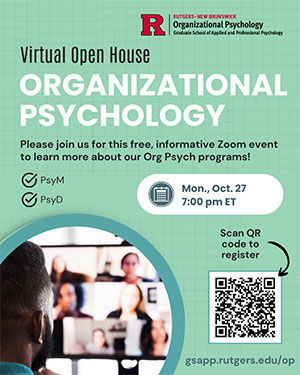
VIRTUAL OPEN HOUSE - Mon, Oct 27th 7:00 pm ET
 The Consortium for Research on Emotional Intelligence in Organizations is headquartered within the Organizational Psychology Program at Rutgers University and provides students with the unique opportunity to conduct research and collaborate with and learn from leading experts in the field of emotional intelligence. The Organizational Psychology program is currently accepting applications for our Doctoral (PsyD) and Master's (PsyM) programs for matriculation in Fall 2026. Click here or scan the QR code below to register for our virtual open house to learn more.
NEW Research Fellowship
think2perform Research Institute’s Research Fellowship program invites proposals from doctoral candidates, post-docs and junior faculty pursuing self-defined research focused on moral intelligence, purpose, and/or emotional intelligence. Click here for more information.
Listen to Consortium member Chuck Wolfe interview some of the thought leaders in emotional intelligence.
Harvard Alumni Panel - Why is interest in Emotional Intelligence Soaring?
Consortium member Chuck Wolfe hosts a panel of world class leaders in the field of emotional intelligence (EI) to talk about why interest in EI is soaring. Panel members include EI Consortium members Dr. Richard Boyatzis, Dr. Cary Cherniss and Dr. Helen Riess. Click here to view the panel discussion.
Interview with Dr. Cary Cherniss and Dr. Cornelia Roche
Host, Chuck Wolfe interviews Drs. Cary Cherniss and Cornelia Roche about their new book Leading with Feeling: Nine Strategies of Emotionally Intelligent Leadership. The authors share powerful stories of cases involving outstanding leaders using strategies that can be learned that demonstrate effective use of emotional intelligence. Click here to see the interview.
Interview with Dr. Rick Aberman
See Chuck Wolfe interview Consortium member and sports psychologist Dr. Rick Aberman on peak performance and dealing with the pandemic. The interview is filled with insights, humorous anecdotes, and strategies for achieving peak performance in athletics and in life. Click here to see the interview.
Interview with Dr. David Caruso
Chuck Wolfe interviews Consortium member David Caruso talking about their work together, the ability model of emotional intelligence, and insights into how to use emotional intelligence to address staying emotionally and mentally healthy during times of crisis and uncertainty. Click here to listen to the interview.
Interview with Dr. Richard Boyazis
How can you help someone to change? Richard Boyatzis is an expert in multiple areas including emotional intelligence. Richard and his coauthors, Melvin Smith, and Ellen Van Oosten, have discovered that helping people connect to their positive vision of themselves or an inspiring dream or goal they've long held is key to creating changes that last. In their book Helping People Change the authors share real stories and research that shows choosing a compassionate over a compliance coaching approach is a far more engaging and successful way to Helping People Change. Click here to listen to the interview.
Interview with Dr. Marc Brackett
Marc Brackett, Director of the Yale Center for Emotional Intelligence, has written a wonderful book about feelings. I worked with Marc when he was first crafting his world class social and emotional learning program, RULER. Our interview highlights how Marc has achieved his own and his Uncle's vision for encouraging each of us to understand and manage our feelings. My conversation with Marc is inspiring, humorous, and engaging at times. Click here to listen to the interview.
Interview with Dr. Helen Riess
Helen Riess is a world class expert on empathy. She is an associate clinical professor of psychiatry at Harvard Medical School and director of the Empathy and Relational Science Program at Mass General Hospital. Helen discusses her new book and shares insights, learnings and techniques such as the powerful seven-step process for understanding and increasing empathy. She relates information and cases whereby she uses empathy to make a meaningful difference in areas such as parenting and leading. Click here to listen to the interview.
Interview with Dr. Maurice Elias
The show is about the Joys and Oys of Parenting, a book written by a respected colleague, Dr. Maurice Elias, an expert in parenting and emotional and social intelligence. Dr. Elias wrote a book tying Judaism and emotional intelligence together to help parents with the challenging, compelling task of raising emotionally healthy children. And while there are fascinating links to Judaism the book is really for everybody. Click here to listen to the interview.
Interview with Geetu Bharwaney
Challenges abound and life is stressful for many. So how do we cope? Chuck Wolfe interviews Geetu Bharwaney about her book, Emotional Resilience. Geetu offers research, insights, and most importantly practical tips for helping people bounce back from adversity. Click here to listen to the interview.
Interview with Dr. Daniel Goleman
Listen to an interview by with Dr. Goleman on his new book Focus: The Hidden Driver of Excellence. In the book Dan helps readers to understand the importance and power of the ability to focus one's attention, will power, and cognitive control in creating life success. Click here to listen to the interview.
Interview with Dr. John Mayer
How Personal Intelligence Shapes Our Lives: A Conversation with John D. Mayer. From picking a life partner, to choosing a career, Jack explains how personal intelligence has a major impact on our ability to make successful decisions. Click here to listen to the interview.
Interview with Dr. Cary Cherniss
Click HERE to listen to an interview with Dr. Cary Cherniss co-chair of the EI Consortium. Dr. Cherniss discusses the issue of emotional intelligence and workplace burnout.
Interview with Dr. Marc Brackett
Click HERE to listen to an interview with Dr. Marc Brackett, the newly appointed leader of the Center of Emotional Intelligence which will begin operation at Yale University in April, 2013. In this interview Dr. Brackett shares his vision for the new center.
