- Reports
- Business Case for Emotional Intelligence
- Do Emotional Intelligence Programs Work?
- Emotional Competence Framework
- Emotional Intelligence: What it is and Why it Matters
- Executives' Emotional Intelligence (mis) Perceptions
- Guidelines for Best Practice
- Guidelines for Securing Organizational Support For EI
- Johnson & Johnson Leadership Study
- Ontario Principals’ Council Leadership Study
- Technical Report on Developing Emotional Intelligence
- Measures
- Emotional Capital Report (ECR)
- Emotional Intelligence Quotient (EQ-i)
- Emotional & Social Competence Inventory 360 (ESCI)
- Emotional & Social Competence Inventory-University (ESCI-U)
- Geneva Emotional Competence Test
- Genos Emotional Intelligence Inventory (Genos EI)
- Team Emotional Intelligence (TEI)
- Mayer Salovey Caruso Emotional Intelligence Test (MSCEIT)
- Profile of Emotional Competence (PEC)
- Schutte Self-Report Inventory (SSRI)
- Six Seconds Emotional Intelligence Assessment (SEI)
- Trait Emotional Intelligence Questionnaire (TEIQue)
- Wong's Emotional Intelligence Scale
- Work Group Emotional Intelligence Profile (WEIP)
- References
- Model Programs
- Achievement Motivation Training
- Care Giver Support Program
- Competency-Based Selection
- Emotional Competence Training - Financial Advisors
- Executive Coaching
- Human Relations Training
- Interaction Management
- Interpersonal Conflict Management - Law Enforcement
- Interpersonal Effectiveness Training - Medical Students
- JOBS Program
- LeaderLAB
- Self-Management Training to Increase Job Attendance
- Stress Management Training
- Weatherhead MBA Program
- Williams' Lifeskills Program
- Article Reprints
- Members
- Events
- Bookstore
Emotional Intelligence in Higher Education
UPDATED APRIL 2015
Ahmad, I., & Rana, S. (2012). Affectivity, achievement motivation, and academic performance in college students. Pakistan Journal of Psychological Research, 27(1), 107-120.
Arora, S., Russ, S., Petrides, K., Sirimanna, P., Aggarwal, R., Darzi, A., & Sevdalis, N. (2011). Emotional intelligence and stress in medical students performing surgical tasks. Academic Medicine, 86(10), 1311-1317. doi: http://dx.doi.org/10.1097/ACM.0b013e31822bd7aa
Atta, M., Hanif, R., Tariq, N., & Akhter, N. (2014). Relationship between emotional intelligence and negative career thoughts in postgraduate unemployed adults. Journal of the Indian Academy of Applied Psychology, 40(2), 261-269.
Ayiro, L. P. (2009). An analysis of emotional intelligence and the performance of principals in selected schools in Kenya. Advances in Developing Human Resources, 11(6), 719-746. doi: http://dx.doi.org/10.1177/1523422309360958
Bay, D., & McKeage, K. (2006). Emotional Intelligence in Undergraduate Accounting Students: Preliminary Assessment. Accounting Education, 15(4), 439-454.
Bowen, J. L. (2014). Emotion in organizations: Resources for business educators. Journal of Management Education, 38(1), 114-142. doi: http://dx.doi.org/10.1177/1052562913488110
Boyatzis, R. E., & Saatcioglu, A. (2008). A 20-year view of trying to develop emotional, social and cognitive intelligence competencies in graduate management education. Journal of Management Development, 27(1), 92-108. doi: http://dx.doi.org/10.1108/02621710810840785
Boyatzis, R. E., Stubbs, E. C., & Taylor, S. N. (2002). Learning Cognitive and Emotional Intelligence Competencies Through Graduate Management Education. Academy of Management Learning & Education, 1(2), 150-162. doi: http://dx.doi.org/10.5465/AMLE.2002.8509345
Camuffo, A., & Gerli, F. (2004). An integrated competency-based approach to management education: An Italian MBA case study. International Journal of Training and Development, 8(4), 240-257. doi: http://dx.doi.org/10.1111/j.1360-3736.2004.00212.x
Camuffo, A., Gerli, F., Borgo, S., & Somia, T. (2009). The effects of management education on careers and compensation: A competency-based study of an Italian MBA programme. Journal of Management Development, 28(9), 839-858. doi: http://dx.doi.org/10.1108/02621710910987683
Carr, S. E. (2009). Emotional intelligence in medical students: Does it correlate with selection measures? Medical Education, 43(11), 1069-1077. doi: http://dx.doi.org/10.1111/j.1365-2923.2009.03496.x
Carrothers, R. M., Gregory, S. W., Jr., & Gallagher, T. J. (2000). Measuring emotional intelligence of medical school applicants. Academic Medicine, 75(5), 456-463. doi: http://dx.doi.org/10.1097/00001888-200005000-00016
Carthy, A., McCann, C., McGilloway, S., & McGuinness, C. (2012). A qualitative study of Irish first year undergraduate students reasons for non-engagement with the provision of emotional competency coaching. The All Ireland Journal of Teaching and Learning in Higher Education, 4(2), 75-99.
Cherry, M., Fletcher, I., O'Sullivan, H., & Dornan, T. (2014). Emotional intelligence in medical education: A critical review. Medical Education, 48(5), 468-478. doi: http://dx.doi.org/10.1111/medu.12406
De Lange, A. C. M., De, J., & D'Aubeterre Lopez, M. E. (2014). Effect of emotional intelligence and immersion in work on stressors and psychological wellbeing: Path analysis in professors. Revista Colombiana de Psicologia, 23(1), 207-228.
Di Fabio, A., & Kenny, M. E. (2015). The contributions of emotional intelligence and social support for adaptive career progress among Italian youth. Journal of Career Development, 42(1), 48-59. doi: http://dx.doi.org/10.1177/0894845314533420
Grehan, P. M., Flanagan, R., & Malgady, R. G. (2011). Successful graduate students: The roles of personality traits and emotional intelligence. Psychology in the Schools, 48(4), 317-331.
Grewal, D., & Davidson, H. A. (2008). Emotional intelligence and graduate medical education. JAMA: Journal of the American Medical Association, 300(10), 1200-1202. doi: http://dx.doi.org/10.1111/j.1365-2923.2010.03709.x
Hen, M., & Goroshit, M. (2011). Emotional competencies in the education of mental health professionals. Social Work Education, 30(7), 811-829. doi: http://dx.doi.org/10.1080/02615479.2010.515680
Hopkins, M. M., O'Neil, D. A., & Williams, H. W. (2007). Emotional intelligence and board governance: Leadership lessons from the public sector. Journal of Managerial Psychology, 22(7), 683-700. doi: http://dx.doi.org/10.1108/02683940710820109
Horton-Deutsch, S., & Sherwood, G. (2008). Reflection: An educational strategy to develop emotionally-competent nurse leaders. Journal of Nursing Management, 16(8), 946-954. doi: http://dx.doi.org/10.1111/j.1365-2834.2008.00957.x
Houghton, J. D., Wu, J., Godwin, J. L., Neck, C. P., & Manz, C. C. (2012). Effective stress management: A model of emotional intelligence, self-leadership, and student stress coping. Journal of Management Education, 36(2), 220-238. doi: http://dx.doi.org/10.1177/1052562911430205
Humphrey-Murto, S., Leddy, J. J., Wood, T. J., Puddester, D., & Moineau, G. (2014). Does emotional intelligence at medical school admission predict future academic performance? Academic Medicine, 89(4), 638-643. doi: http://dx.doi.org/10.1097/ACM.0000000000000165
Kafetsios, K., Nezlek, J. B., & Vassiou, A. (2011). A multilevel analysis of relationships between leaders' and subordinates' emotional intelligence and emotional outcomes. Journal of Applied Social Psychology, 41(5), 1121-1144. doi: http://dx.doi.org/10.1111/j.1559-1816.2011.00750.x
Kingston, E. (2008). Emotional competence and drop-out rates in higher education. Education & Training, 50(2), 128-139.
Larin, H. M., Benson, G., Martin, L., Wessel, J., Williams, R., & Ploeg, J. (2011). Examining change in emotional-social intelligence, caring, and leadership in health professions students. Journal of Allied Health, 40(2), 96-102.
Leonard, N. H., & Harvey, M. (2007). The trait of curiosity as a predictor of emotional intelligence. Journal of Applied Social Psychology, 37(7), 1545-1561. doi: http://dx.doi.org/10.1111/j.1559-1816.2007.00226.x
Lewis, N. J., Rees, C. E., Hudson, J. N., & Bleakley, A. (2005). Emotional Intelligence Medical Education: Measuring the Unmeasurable? Advances in Health Sciences Education, 10(4), 339-355.
Libbrecht, N., Lievens, F., Carette, B., & Cote, S. (2014). Emotional intelligence predicts success in medical school. Emotion, 14(1), 64-73. doi: http://dx.doi.org/10.1037/a0034392
Lillis, M. P. (2011). Faculty emotional intelligence and student-faculty interactions: Implications for student retention. Journal of College Student Retention: Research, Theory and Practice, 13(2), 155-178. doi: http://dx.doi.org/10.2190/CS.13.2.b
Liu, Y., Peng, K., & Wong, C.-S. (2014). Career maturity and job attainment: The moderating roles of emotional intelligence and social vocational interest. International Journal for Educational and Vocational Guidance, 14(3), 293-307. doi: http://dx.doi.org/10.1007/s10775-014-9271-5
Manring, S. L. (2012). Tapping and fostering students' emotional intelligence through service-learning experiences. Journal of Behavioral and Applied Management, 13(3), 168-185.
Margavio, T. M., Margavio, G. W., Hignite, M. A., & Moses, D. R. (2012). A comparative analysis of the emotional intelligence levels of American and Chinese business students. College Student Journal, 46(4), 776-787.
Montasem, A., Brown, S. L., & Harris, R. (2013). Do core self-evaluations and trait emotional intelligence predict subjective well-being in dental students? Journal of Applied Social Psychology, 43(5), 1097-1103. doi: http://dx.doi.org/10.1111/jasp.12074
Neumann, M., Edelhauser, F., Tauschel, D., Fischer, M. R., Wirtz, M., Woopen, C., . . . Scheffer, C. (2011). Empathy decline and its reasons: A systematic review of studies with medical students and residents. Academic Medicine, 86(8), 996-1009. doi: http://dx.doi.org/10.1097/ACM.0b013e318221e615
Newsome, S., Day, A. L., & Catano, V. M. (2000). Assessing the predictive validity of emotional intelligence. Personality and Individual Differences, 29(6), 1005-1016. doi: http://dx.doi.org/10.1016/S0191-8869%2899%2900250-0
Patti, J., Holzer, A. A., Stern, R., & Brackett, M. A. (2012). Personal, Professional Coaching: Transforming Professional Development for Teacher and Administrative Leaders. Journal of Education Leadership, 11(1), 263-274.
Potgieter, I., & Coetzee, M. (2013). Emotional intelligence as a predictor of postgraduate students' psychosocial employability attributes. Journal of Psychology in Africa, 23(2), 187-194.
Puffer, K. A. (2011). Emotional intelligence as a salient predictor for collegians' career decision making. Journal of Career Assessment, 19(2), 130-150. doi: http://dx.doi.org/10.1177/1069072710385545
Rashid, T., & Mohammadyfar, M. A. (2009). Validation and standardization of the Emotional Skills and Competence Questionnaire (ESCQ) among Indian university students. Psiholoska Obzorja/Horizons of Psychology, 18(3), 87-97.
Reilly, P. (2005). Teaching Law Students How to Feel: Using Negotiations Training to Increase Emotional Intelligence. Negotiation Journal, 21(2), 301-314. doi: http://dx.doi.org/10.1111/j.1571-9979.2005.00065.x
Rieck, T., & Callahan, J. L. (2013). Emotional intelligence and psychotherapy outcomes in the training clinic. Training and Education in Professional Psychology, 7(1), 42-52. doi: http://dx.doi.org/10.1037/a0031659
Rozell, E. J., Pettijohn, C. E., & Parker, R. (2002). An empirical evaluation of emotional intelligence: The impact on management development. Journal of Management Development, 21(4), 272-289. doi: http://dx.doi.org/10.1108/02621710210430272
Saklofske, D. H., Austin, E. J., Mastoras, S. M., Beaton, L., & Osborne, S. E. (2012). Relationships of personality, affect, emotional intelligence and coping with student stress and academic success: Different patterns of association for stress and success. Learning and Individual Differences, 22(2), 251-257. doi: http://dx.doi.org/10.1016/j.lindif.2011.02.010
Sanchez-Ruiz, M.-J., Mavroveli, S., & Poullis, J. (2013). Trait emotional intelligence and its links to university performance: An examination. Personality and Individual Differences, 54(5), 658-662. doi: http://dx.doi.org/10.1016/j.paid.2012.11.013
Schutte, N. S. (2014). Social environment contexts of trait emotional intelligence. Journal of Human Behavior in the Social Environment, 24(7), 741-750. doi: http://dx.doi.org/10.1080/10911359.2013.866065
Sheldon, O. J., Dunning, D., & Ames, D. R. (2014). Emotionally unskilled, unaware, and uninterested in learning more: Reactions to feedback about deficits in emotional intelligence. Journal of Applied Psychology, 99(1), 125-137. doi: http://dx.doi.org/10.1037/a0034138
Stevens, C. K., & Gist, M. E. (1997). Effects of self-efficacy and goal-orientation training on negotiation skill maintenance: What are the mechanisms? Personnel Psychology, 50(4), 955-978. doi: http://dx.doi.org/10.1111/j.1744-6570.1997.tb01490.x
Stratton, T. D., Saunders, J. A., & Elam, C. L. (2008). Changes in medical students' emotional intelligence: An exploratory study. Teaching and Learning in Medicine, 20(3), 279-284.
Tang, H.-W. V., Yin, M.-S., & Nelson, D. B. (2010). The relationship between emotional intelligence and leadership practices: A cross-cultural study of academic leaders in Taiwan and the USA. Journal of Managerial Psychology, 25(8), 899-926. doi: http://dx.doi.org/10.1108/02683941011089143
Tett, R. P., & Fox, K. E. (2006). Confirmatory factor structure of trait emotional intelligence in student and worker samples. Personality and Individual Differences, 41(6), 1155-1168. doi: http://dx.doi.org/10.1016/j.paid.2006.03.027
Todres, M., Tsimtsiou, Z., Stephenson, A., & Jones, R. (2010). The emotional intelligence of medical students: An exploratory cross-sectional study. Medical Teacher, 32(1), e42-e48. doi: http://dx.doi.org/10.3109/01421590903199668
Tok, S., & Morali, S. L. (2009). Trait emotional intelligence, the Big Five personality dimensions and academic success in physical education teacher candidates. Social Behavior and Personality, 37(7), 921-932.
Williams, H. W. (2008). Characteristics that distinguish outstanding urban principals: Emotional intelligence, social intelligence and environmental adaptation. Journal of Management Development, 27(1), 36-54. doi: http://dx.doi.org/10.1108/02621710810840758
Wurf, G., & Croft-Piggin, L. (2015). Predicting the academic Achievement of first-year, pre-service teachers: The role of engagement, motivation, ATAR, and emotional intelligence. Asia-Pacific Journal of Teacher Education, 43(1), 75-91. doi: http://dx.doi.org/10.1080/1359866X.2014.932328
Yew Ming, C. (2005). Job offers of multi-national accounting firms: the effects of emotional intelligence, extra-curricular activities, and academic performance. [Article]. Accounting Education, 14(1), 75-93. doi: 10.1080/0693928042000229707
Zysberg, L., Levy, A., & Zisberg, A. (2011). Emotional intelligence in applicant selection for care-related academic programs. Journal of Psychoeducational Assessment, 29(1), 27-38. doi: http://dx.doi.org/10.1177/0734282910365059

News and Events
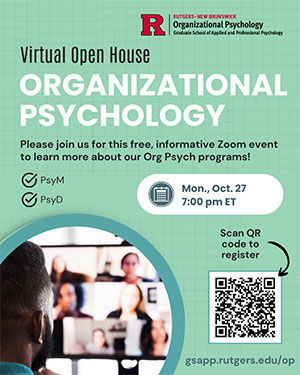
VIRTUAL OPEN HOUSE - Mon, Oct 27th 7:00 pm ET
 The Consortium for Research on Emotional Intelligence in Organizations is headquartered within the Organizational Psychology Program at Rutgers University and provides students with the unique opportunity to conduct research and collaborate with and learn from leading experts in the field of emotional intelligence. The Organizational Psychology program is currently accepting applications for our Doctoral (PsyD) and Master's (PsyM) programs for matriculation in Fall 2026. Click here or scan the QR code below to register for our virtual open house to learn more.
NEW Research Fellowship
think2perform Research Institute’s Research Fellowship program invites proposals from doctoral candidates, post-docs and junior faculty pursuing self-defined research focused on moral intelligence, purpose, and/or emotional intelligence. Click here for more information.
Listen to Consortium member Chuck Wolfe interview some of the thought leaders in emotional intelligence.
Harvard Alumni Panel - Why is interest in Emotional Intelligence Soaring?
Consortium member Chuck Wolfe hosts a panel of world class leaders in the field of emotional intelligence (EI) to talk about why interest in EI is soaring. Panel members include EI Consortium members Dr. Richard Boyatzis, Dr. Cary Cherniss and Dr. Helen Riess. Click here to view the panel discussion.
Interview with Dr. Cary Cherniss and Dr. Cornelia Roche
Host, Chuck Wolfe interviews Drs. Cary Cherniss and Cornelia Roche about their new book Leading with Feeling: Nine Strategies of Emotionally Intelligent Leadership. The authors share powerful stories of cases involving outstanding leaders using strategies that can be learned that demonstrate effective use of emotional intelligence. Click here to see the interview.
Interview with Dr. Rick Aberman
See Chuck Wolfe interview Consortium member and sports psychologist Dr. Rick Aberman on peak performance and dealing with the pandemic. The interview is filled with insights, humorous anecdotes, and strategies for achieving peak performance in athletics and in life. Click here to see the interview.
Interview with Dr. David Caruso
Chuck Wolfe interviews Consortium member David Caruso talking about their work together, the ability model of emotional intelligence, and insights into how to use emotional intelligence to address staying emotionally and mentally healthy during times of crisis and uncertainty. Click here to listen to the interview.
Interview with Dr. Richard Boyazis
How can you help someone to change? Richard Boyatzis is an expert in multiple areas including emotional intelligence. Richard and his coauthors, Melvin Smith, and Ellen Van Oosten, have discovered that helping people connect to their positive vision of themselves or an inspiring dream or goal they've long held is key to creating changes that last. In their book Helping People Change the authors share real stories and research that shows choosing a compassionate over a compliance coaching approach is a far more engaging and successful way to Helping People Change. Click here to listen to the interview.
Interview with Dr. Marc Brackett
Marc Brackett, Director of the Yale Center for Emotional Intelligence, has written a wonderful book about feelings. I worked with Marc when he was first crafting his world class social and emotional learning program, RULER. Our interview highlights how Marc has achieved his own and his Uncle's vision for encouraging each of us to understand and manage our feelings. My conversation with Marc is inspiring, humorous, and engaging at times. Click here to listen to the interview.
Interview with Dr. Helen Riess
Helen Riess is a world class expert on empathy. She is an associate clinical professor of psychiatry at Harvard Medical School and director of the Empathy and Relational Science Program at Mass General Hospital. Helen discusses her new book and shares insights, learnings and techniques such as the powerful seven-step process for understanding and increasing empathy. She relates information and cases whereby she uses empathy to make a meaningful difference in areas such as parenting and leading. Click here to listen to the interview.
Interview with Dr. Maurice Elias
The show is about the Joys and Oys of Parenting, a book written by a respected colleague, Dr. Maurice Elias, an expert in parenting and emotional and social intelligence. Dr. Elias wrote a book tying Judaism and emotional intelligence together to help parents with the challenging, compelling task of raising emotionally healthy children. And while there are fascinating links to Judaism the book is really for everybody. Click here to listen to the interview.
Interview with Geetu Bharwaney
Challenges abound and life is stressful for many. So how do we cope? Chuck Wolfe interviews Geetu Bharwaney about her book, Emotional Resilience. Geetu offers research, insights, and most importantly practical tips for helping people bounce back from adversity. Click here to listen to the interview.
Interview with Dr. Daniel Goleman
Listen to an interview by with Dr. Goleman on his new book Focus: The Hidden Driver of Excellence. In the book Dan helps readers to understand the importance and power of the ability to focus one's attention, will power, and cognitive control in creating life success. Click here to listen to the interview.
Interview with Dr. John Mayer
How Personal Intelligence Shapes Our Lives: A Conversation with John D. Mayer. From picking a life partner, to choosing a career, Jack explains how personal intelligence has a major impact on our ability to make successful decisions. Click here to listen to the interview.
Interview with Dr. Cary Cherniss
Click HERE to listen to an interview with Dr. Cary Cherniss co-chair of the EI Consortium. Dr. Cherniss discusses the issue of emotional intelligence and workplace burnout.
Interview with Dr. Marc Brackett
Click HERE to listen to an interview with Dr. Marc Brackett, the newly appointed leader of the Center of Emotional Intelligence which will begin operation at Yale University in April, 2013. In this interview Dr. Brackett shares his vision for the new center.
