- Reports
- Business Case for Emotional Intelligence
- Do Emotional Intelligence Programs Work?
- Emotional Competence Framework
- Emotional Intelligence: What it is and Why it Matters
- Executives' Emotional Intelligence (mis) Perceptions
- Guidelines for Best Practice
- Guidelines for Securing Organizational Support For EI
- Johnson & Johnson Leadership Study
- Ontario Principals’ Council Leadership Study
- Technical Report on Developing Emotional Intelligence
- Measures
- Emotional Capital Report (ECR)
- Emotional Intelligence Quotient (EQ-i)
- Emotional & Social Competence Inventory 360 (ESCI)
- Emotional & Social Competence Inventory-University (ESCI-U)
- Geneva Emotional Competence Test
- Genos Emotional Intelligence Inventory (Genos EI)
- Team Emotional Intelligence (TEI)
- Mayer Salovey Caruso Emotional Intelligence Test (MSCEIT)
- Profile of Emotional Competence (PEC)
- Schutte Self-Report Inventory (SSRI)
- Six Seconds Emotional Intelligence Assessment (SEI)
- Trait Emotional Intelligence Questionnaire (TEIQue)
- Wong's Emotional Intelligence Scale
- Work Group Emotional Intelligence Profile (WEIP)
- References
- Model Programs
- Achievement Motivation Training
- Care Giver Support Program
- Competency-Based Selection
- Emotional Competence Training - Financial Advisors
- Executive Coaching
- Human Relations Training
- Interaction Management
- Interpersonal Conflict Management - Law Enforcement
- Interpersonal Effectiveness Training - Medical Students
- JOBS Program
- LeaderLAB
- Self-Management Training to Increase Job Attendance
- Stress Management Training
- Weatherhead MBA Program
- Williams' Lifeskills Program
- Article Reprints
- Members
- Events
- Bookstore
Emotional Intelligence and Leadership
UPDATED APRIL 2015
Ahmetoglu, G., Leutner, F., & Chamorro-Premuzic, T. (2011). EQ-nomics: Understanding the relationship between individual differences in trait emotional intelligence and entrepreneurship. Personality and Individual Differences, 51(8), 1028-1033. doi: http://dx.doi.org/10.1016/j.paid.2011.08.016
Antonakis, J., Ashkanasy, N. M., & Dasborough, M. T. (2009). Does leadership need emotional intelligence? The Leadership Quarterly, 20(2), 247-261. doi: http://dx.doi.org/10.1016/j.leaqua.2009.01.006
Ashkanasy, N. M., & Daus, C. S. (2002). Emotion in the workplace: The new challenge for managers. Academy of Management Executive, 16(1), 76-86. doi: http://dx.doi.org/10.5465/ame.2002.6640191
Barbuto, J. E., Jr., Gottfredson, R. K., & Searle, T. P. (2014). An examination of emotional intelligence as an antecedent of servant leadership. Journal of Leadership & Organizational Studies, 21(3), 315-323. doi: http://dx.doi.org/10.1177/1548051814531826
Blattner, J., & Bacigalupo, A. (2007). Using emotional intelligence to develop executive leadership and team and organizational development. Consulting Psychology Journal: Practice and Research, 59(3), 209-219. doi: http://dx.doi.org/10.1037/1065-9293.59.3.209
Bratton, V. K., Dodd, N. G., & Brown, F. (2011). The impact of emotional intelligence on accuracy of self-awareness and leadership performance. Leadership & Organization Development Journal, 32(2), 127-149.
Brotheridge, C. M., & Lee, R. T. (2008). The emotions of managing: An introduction to the special issue. Journal of Managerial Psychology, 23(2), 108-117.
Camuffo, A., Gerli, F., & Gubitta, P. (2012). Competencies matter: Modeling effective entrepreneurship in Northeast of Italy small firms. Cross Cultural Management, 19(1), 48-66. doi: http://dx.doi.org/10.1108/13527601211195628
Castro, F., Gomes, J., & de Sousa, F. C. (2012). Do intelligent leaders make a difference? The effect of a leader's emotional intelligence on followers' creativity. Creativity and Innovation Management, 21(2), 171-182. doi: http://dx.doi.org/10.1111/j.1467-8691.2012.00636.x
Cavazotte, F., Moreno, V., & Hickmann, M. (2012). Effects of leader intelligence, personality and emotional intelligence on transformational leadership and managerial performance. The Leadership Quarterly, 23(3), 443-455. doi: http://dx.doi.org/10.1016/j.leaqua.2011.10.003
Chan, K.-Y., Uy, M. A., Chernyshenko, O. S., Ho, M.-H. R., & Sam, Y.-L. (2015). Personality and entrepreneurial, professional and leadership motivations. Personality and Individual Differences, 77, 161-166.
Chrusciel, D. (2008). What motivates the significant/strategic change champion(s)? Journal of Organizational Change Management, 21(2), 148-160. doi: http://dx.doi.org/10.1108/09534810810856408
Clarke, N. (2010). Emotional intelligence and its relationship to transformational leadership and key project manager competences. [Article]. Project Management Journal, 41(2), 5-20. doi: http://dx.doi.org/10.1002/pmj.20162
Cote, S., Lopes, P. N., Salovey, P., & Miners, C. T. (2010). Emotional intelligence and leadership emergence in small groups. The Leadership Quarterly, 21(3), 496-508. doi: http://dx.doi.org/10.1016/j.leaqua.2010.03.012
Cross, B., & Travaglione, A. (2003). The Untold Story: Is the Entrepreneur of the 21st Century Defined by Emotional Intelligence? The International Journal of Organizational Analysis, 11(3), 221-228. doi: http://dx.doi.org/10.1108/eb028973
Dasborough, M. T. (2006). Cognitive asymmetry in employee emotional reactions to leadership behaviors. The Leadership Quarterly, 17(2), 163-178. doi: http://dx.doi.org/10.1016/j.leaqua.2005.12.004
Downey, L., Papageorgiou, V., & Stough, C. (2006). Examining the relationship between leadership, emotional intelligence and intuition in senior female managers. Leadership & Organization Development Journal, 27(4), 250-264. doi: http://dx.doi.org/10.1108/01437730610666019
Drodge, E. N., & Murphy, S. A. (2002). Interrogating Emotions in Police Leadership. Human Resource Development Review, 1(4), 420-438. doi: http://dx.doi.org/10.1177/1534484302238435
Fambrough, M. J., & Hart, R. K. (2008). Emotions in leadership development: A critique of emotional intelligence. Advances in Developing Human Resources, 10(5), 740-758. doi: http://dx.doi.org/10.1177/1523422308323542
Gardner, L., & Stough, C. (2002). Examining the relationship between leadership and emotional intelligence in senior level managers. Leadership & Organization Development Journal, 23(2), 68-78. doi: http://dx.doi.org/10.1108/01437730210419198
Gardner, W. L., Fischer, D., & Hunt, J. G. (2009). Emotional labor and leadership: A threat to authenticity? The Leadership Quarterly, 20(3), 466-482. doi: http://dx.doi.org/10.1016/j.leaqua.2009.03.011
George, J. M. (2000). Emotions and leadership: The role of emotional intelligence. Human Relations, 53(8), 1027-1055. doi: http://dx.doi.org/10.1177/0018726700538001
Goleman, D. (2000). Leadership that gets results. Harvard Business Review, 78(2), 78-90.
Goleman, D. (2004). What Makes a Leader? [Article]. Harvard Business Review, 82(1), 82-91.
Goleman, D., & Boyatzis, R. (2008). Social Intelligence and the Biology of Leadership. [Article]. Harvard Business Review, 86(9), 74-81.
Goleman, D., Boyatzis, R., & McKee, A. (2001). Primal Leadership: The Hidden Driver of Great Performance. [Article]. Harvard Business Review, 79(11), 42-51.
Gooty, J., Connelly, S., Griffith, J., & Gupta, A. (2010). Leadership, affect and emotions: A state of the science review. The Leadership Quarterly, 21(6), 979-1004. doi: http://dx.doi.org/10.1016/j.leaqua.2010.10.005
Harrison, J. K., & Clough, M. W. (2006). Characteristics of “state of the art” leaders: Productive narcissism versus emotional intelligence and Level 5 capabilities. [Article]. Social Science Journal, 43(2), 287-292. doi: http://dx.doi.org/10.1016/j.soscij.2006.02.007
Hawkins, J., & Dulewicz, V. (2009). Relationships between Leadership Style, the Degree of Change Experienced, Performance and Follower Commitment in Policing. [Article]. Journal of Change Management, 9(3), 251-270. doi: http://dx.doi.org/10.1080/14697010903125498
Higgs, M., & Aitken, P. (2003). An exploration of the relationship between emotional intelligence and leadership potential. Journal of Managerial Psychology, 18(8), 814-823. doi: http://dx.doi.org/10.1108/02683940310511890
Hong, Y., Catano, V. M., & Liao, H. (2011). Leader emergence: The role of emotional intelligence and motivation to lead. Leadership & Organization Development Journal, 32(4), 320-343.
Hopkins, M. M., O'Neil, D. A., & Williams, H. W. (2007). Emotional intelligence and board governance: Leadership lessons from the public sector. Journal of Managerial Psychology, 22(7), 683-700. doi: http://dx.doi.org/10.1108/02683940710820109
Huang, X., Chan, S. C., Lam, W., & Nan, X. (2010). The joint effect of leader-member exchange and emotional intelligence on burnout and work performance in call centers in china. The International Journal of Human Resource Management, 21(7), 1124-1144. doi: http://dx.doi.org/10.1080/09585191003783553
Humphrey, R. H. (2002). The many faces of emotional leadership. The Leadership Quarterly, 13(5), 493-504. doi: http://dx.doi.org/10.1016/S1048-9843%2802%2900140-6
Humphrey, R. H., Pollack, J. M., & Hawver, T. (2008). Leading with emotional labor. Journal of Managerial Psychology, 23(2), 151-168.
Humphreys, J. H., Weyant, L. E., & Sprague, R. D. (2003). Organizational Commitment: The Roles of Emotional and Practical Intellect within the Leader/Follower Dyad. [Article]. Journal of Business & Management, 9(2), 189.
Hur, Y., van den Berg, P. T., & Wilderom, C. P. (2011). Transformational leadership as a mediator between emotional intelligence and team outcomes. The Leadership Quarterly, 22(4), 591-603.
Jacobs, R. L., & McClelland, D. C. (1994). Moving up the corporate ladder: A longitudinal study of the leadership motive pattern and managerial success in women and men. Consulting Psychology Journal: Practice and Research, 46(1), 32-41. doi: http://dx.doi.org/10.1037/1061-4087.46.1.32
Jordan, P. J., & Troth, A. (2011). Emotional intelligence and leader member exchange: The relationship with employee turnover intentions and job satisfaction. Leadership & Organization Development Journal, 32(3), 260-280. doi: http://dx.doi.org/10.1108/01437731111123915
Kafetsios, K., Nezlek, J. B., & Vassiou, A. (2011). A multilevel analysis of relationships between leaders' and subordinates' emotional intelligence and emotional outcomes. Journal of Applied Social Psychology, 41(5), 1121-1144. doi: http://dx.doi.org/10.1111/j.1559-1816.2011.00750.x
Kellett, J. B., Humphrey, R. H., & Sleeth, R. G. (2006). Empathy and the emergence of task and relations leaders. The Leadership Quarterly, 17(2), 146-162. doi: http://dx.doi.org/10.1016/j.leaqua.2005.12.003
Kerr, R., Garvin, J., Heaton, N., & Boyle, E. (2006). Emotional intelligence and leadership effectiveness. Leadership & Organization Development Journal, 27(4), 265-279. doi: http://dx.doi.org/10.1108/01437730610666028
Klem, C., & Schlechter, A. F. (2008). The relationship between leader emotional intelligence and psychological climate: An exploratory study. [Article]. South African Journal of Business Management, 39(2), 9-23.
Koman, E. S., & Wolff, S. B. (2008). Emotional intelligence competencies in the team and team leader: A multi-level examination of the impact of emotional intelligence on team performance. Journal of Management Development, 27(1), 55-75. doi: http://dx.doi.org/10.1108/02621710810840767
Lam, C. S., & O'Higgins, E. R. (2012). Enhancing employee outcomes: The interrelated influences of managers' emotional intelligence and leadership style. Leadership & Organization Development Journal, 33(2), 149-174. doi: http://dx.doi.org/10.1108/01437731211203465
Larin, H. M., Benson, G., Martin, L., Wessel, J., Williams, R., & Ploeg, J. (2011). Examining change in emotional-social intelligence, caring, and leadership in health professions students. Journal of Allied Health, 40(2), 96-102.
Lindebaum, D., & Cartwright, S. (2011). Leadership effectiveness: The costs and benefits of being emotionally intelligent. Leadership & Organization Development Journal, 32(3), 281-290. doi: http://dx.doi.org/10.1108/01437731111123924
Lucas, V., Laschinger, H. K., & Wong, C. A. (2008). The impact of emotional intelligent leadership on staff nurse empowerment: The moderating effect of span of control. Journal of Nursing Management, 16(8), 964-973. doi: http://dx.doi.org/10.1111/j.1365-2834.2008.00856.x
Miao C, Humphrey R.H, Qian S. (2021)Emotional intelligence and servant leadership: A metaanalytic review. Business Ethics: A Eur Rev, 00, 1-13. https://doi.org/10.1111/beer.12332
Mandell, B., & Pherwani, S. (2003). Relationship between emotional leadership style: A gender comparison. Journal of Business and Psychology, 17(3), 387-404. doi: http://dx.doi.org/10.1023/A:1022816409059
McCleskey, J. (2014). Emotional intelligence and leadership: A review of the progress, controversy, and criticism. International Journal of Organizational Analysis, 22(1), 76-93. doi: http://dx.doi.org/10.1108/IJOA-03-2012-0568
Momeni, N. (2009). The Relation Between Managers' emotional intelligence and the organizational climate they create. Public Personnel Management, 38(2), 35-48.
Mortan, R. A., Ripoll, P., Carvalho, C., & Bernal, M. (2014). Effects of emotional intelligence on entrepreneurial intention and self-efficacy. Revista de Psicologia del Trabajo y de las Organizaciones, 30(3), 97-104.
Moss, S., Ritossa, D., & Ngu, S. (2006). The effect of follower regulatory focus and extraversion on leadership behavior: The role of emotional intelligence. Journal of Individual Differences, 27(2), 93-107. doi: http://dx.doi.org/10.1027/1614-0001.27.2.93
Palmer, B., Walls, M., Burgess, Z., & Stough, C. (2001). Emotional intelligence and effective leadership. Leadership & Organization Development Journal, 22(1), 5-10. doi: http://dx.doi.org/10.1108/01437730110380174
Rahim, M., & Psenicka, C. (2005). Relationship between emotional intelligence and effectiveness of leader role: A dyadic study in four countries. International Journal of Organizational Analysis, 13(4), 327-342. doi: http://dx.doi.org/10.1108/eb029010
Rajah, R., Song, Z., & Arvey, R. D. (2011). Emotionality and leadership: Taking stock of the past decade of research. The Leadership Quarterly, 22(6), 1107-1119. doi: http://dx.doi.org/10.1016/j.leaqua.2011.09.006
Ramo, L. G., Saris, W. E., & Boyatzis, R. E. (2009). The impact of social and emotional competencies on effectiveness of Spanish executives. Journal of Management Development, 28(9), 771-793. doi: http://dx.doi.org/10.1108/02621710910987656
Rego, A., Sousa, F., Pina e Cunha, M., Correia, A., & Saur-Amaral, I. (2007). Leader Self-Reported Emotional Intelligence and Perceived Employee Creativity: An Exploratory Study. [Article]. Creativity & Innovation Management, 16(3), 250-264. doi: http://dx.doi.org/10.1111/j.1467-8691.2007.00435.x
Riggio, R. E., & Reichard, R. J. (2008). The emotional and social intelligences of effective leadership: An emotional and social skill approach. Journal of Managerial Psychology, 23(2), 169-185.
Rosete, D., & Ciarrochi, J. (2005). Emotional intelligence and its relationship to workplace performance outcomes of leadership effectiveness. Leadership & Organization Development Journal, 26(5), 388-399. doi: http://dx.doi.org/10.1108/01437730510607871
Rubin, R. S., Munz, D. C., & Bommer, W. H. (2005). Leading from within: The effects of emotion recognition and personality on transformational leadership behavior. [Article]. Academy of Management Journal, 48(5), 845-858. doi: http://dx.doi.org/10.5465/amj.2005.18803926
Ryan, G., Emmerling, R. J., & Spencer, L. M. (2009). Distinguishing high-performing European executives: The role of emotional, social and cognitive competencies. Journal of Management Development, 28(9), 859-875. doi: http://dx.doi.org/10.1108/02621710910987692
Sadri, G. (2012). Emotional intelligence and leadership development. Public Personnel Management, 41(3), 535-548. doi: http://dx.doi.org/10.1177/009102601204100308
Sanchez-Burks, J., & Huy, Q. N. (2009). Emotional Aperture and Strategic Change: The Accurate Recognition of Collective Emotions. [Article]. Organization Science, 20(1), 22-34.
Schlaerth, A., Ensari, N., & Christian, J. (2013). A meta-analytical review of the relationship between emotional intelligence and leaders' constructive conflict management. Group Processes & Intergroup Relations, 16(1), 126-136. doi: http://dx.doi.org/10.1177/1368430212439907
Sears, G. J., & Holmvall, C. M. (2010). The joint influence of supervisor and subordinate emotional intelligence on leader-member exchange. Journal of Business and Psychology, 25(4), 593-605. doi: http://dx.doi.org/10.1007/s10869-009-9152-y
Severinsson, E. (2010). Guest editorial: The role of reflective leadership, supervision as well as emotional intelligence in nursing and midwifery. [Editorial]. Journal of Nursing Management, 18(4), 351-354.
Siegling, A., Nielsen, C., & Petrides, K. (2014). Trait emotional intelligence and leadership in a European multinational company. Personality and Individual Differences, 65, 65-68. doi: http://dx.doi.org/10.1016/j.paid.2014.01.049
Singh, A. K., Singh, S., & Singh, A. (2014). Personality traits and turnover intention among front level managerial personnel. Journal of the Indian Academy of Applied Psychology, 40(2), 228-236.
Sivanathan, N., & Fekken, G. (2002). Emotional intelligence, moral reasoning and transformational leadership. Leadership & Organization Development Journal, 23(4), 198-204. doi: http://dx.doi.org/10.1108/01437730210429061
Smollan, R., & Parry, K. (2011). Follower perceptions of the emotional intelligence of change leaders: A qualitative study. Leadership, 7(4), 435-462. doi: http://dx.doi.org/10.1177/1742715011416890
Sosik, J. J., & Megerian, L. E. (1999). Understanding leader emotional intelligence and performance: The role of self-other agreement on transformational leadership perceptions. Group & Organization Management, 24(3), 367-390. doi: http://dx.doi.org/10.1177/1059601199243006
Srivsastava, K. B., & Bharamanaikar, S. (2004). Emotional Intelligence and Effective Leadership Behaviour. Psychological Studies, 49(2-3), 107-113.
Stein, S. J., Papadogiannis, P., Yip, J. A., & Sitarenios, G. (2009). Emotional intelligence of leaders: A profile of top executives. Leadership & Organization Development Journal, 30(1), 87-101. doi: http://dx.doi.org/10.1108/01437730910927115
Tang, H.-W. V., Yin, M.-S., & Nelson, D. B. (2010). The relationship between emotional intelligence and leadership practices: A cross-cultural study of academic leaders in Taiwan and the USA. Journal of Managerial Psychology, 25(8), 899-926. doi: http://dx.doi.org/10.1108/02683941011089143
Taylor, S. N., & Hood, J. N. (2011). It may not be what you think: Gender differences in predicting emotional and social competence. Human Relations, 64(5), 627-652. doi: http://dx.doi.org/10.1177/0018726710387950
Troth, A. C., & Gyetvey, C. (2014). Identifying leadership potential in an Australian context. Asia Pacific Journal of Human Resources, 52(3), 333-350. doi: http://dx.doi.org/10.1111/1744-7941.12034
Vidyarthi, P. R., Anand, S., & Liden, R. C. (2014). Do emotionally perceptive leaders motivate higher employee performance? The moderating role of task interdependence and power distance. The Leadership Quarterly, 25(2), 232-244. doi: http://dx.doi.org/10.1016/j.leaqua.2013.08.003
Wang, Y.-S., & Huang, T.-C. (2009). The relationship of transformational leadership with group cohesiveness and emotional intelligence. Social Behavior and Personality, 37(3), 379-392. doi: http://dx.doi.org/10.2224/sbp.2009.37.3.379
Webb, K. S. (2009). Why Emotional Intelligence Should Matter to Management: A Survey of the Literature. [Article]. SAM Advanced Management Journal (07497075), 74(2), 32-41.
Weinberger, L. A. (2002). Emotional Intelligence: Its Connection to HRD Theory and Practice. Human Resource Development Review, 1(2), 215-243. doi: http://dx.doi.org/10.1177/15384302001002005
Weinberger, L. A. (2009). Emotional intelligence, leadership style, and perceived leadership effectiveness. Advances in Developing Human Resources, 11(6), 747-772. doi: http://dx.doi.org/10.1177/1523422309360811
Williams, H. W. (2008). Characteristics that distinguish outstanding urban principals: Emotional intelligence, social intelligence and environmental adaptation. Journal of Management Development, 27(1), 36-54. doi: http://dx.doi.org/10.1108/02621710810840758
Wong, C.-S., & Law, K. S. (2002). The effects of leader and follower emotional intelligence on performance and attitude: An exploratory study. The Leadership Quarterly, 13(3), 243-274. doi: http://dx.doi.org/10.1016/S1048-9843%2802%2900099-1
Wu, W., Liu, Y., Song, L. J., & Liu, J. (2006). Effects of organizational leadership on employee commitment: The moderating role of emotional intelligence. Journal of Psychology in Chinese Societies, 7(2), 283-306.
Yunus, N. H., Ghazali, K., & Hassan, C. N. (2011). The influence of leader's emotional intelligence: Mediating effect of leader-member exchange on employees' organizational citizenship behaviors. Interdisciplinary Journal of Contemporary Research in Business, 3(3), 1125-1134.
Zampetakis, L. A., & Moustakis, V. (2011). Managers' trait emotional intelligence and group outcomes: The case of group job satisfaction. Small Group Research, 42(1), 77-102. doi: http://dx.doi.org/10.1177/1046496410373627
Zhou, J., & George, J. M. (2003). Awakening employee creativity: The role of leader emotional intelligence. The Leadership Quarterly, 14(4-5), 545-568. doi: http://dx.doi.org/10.1016/S1048-9843%2803%2900051-1

News and Events
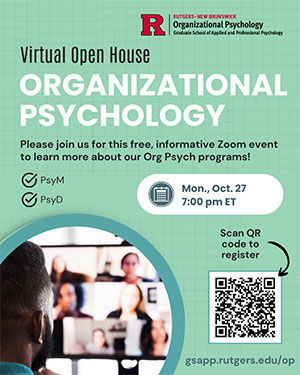
VIRTUAL OPEN HOUSE - Mon, Oct 27th 7:00 pm ET
 The Consortium for Research on Emotional Intelligence in Organizations is headquartered within the Organizational Psychology Program at Rutgers University and provides students with the unique opportunity to conduct research and collaborate with and learn from leading experts in the field of emotional intelligence. The Organizational Psychology program is currently accepting applications for our Doctoral (PsyD) and Master's (PsyM) programs for matriculation in Fall 2026. Click here or scan the QR code below to register for our virtual open house to learn more.
NEW Research Fellowship
think2perform Research Institute’s Research Fellowship program invites proposals from doctoral candidates, post-docs and junior faculty pursuing self-defined research focused on moral intelligence, purpose, and/or emotional intelligence. Click here for more information.
Listen to Consortium member Chuck Wolfe interview some of the thought leaders in emotional intelligence.
Harvard Alumni Panel - Why is interest in Emotional Intelligence Soaring?
Consortium member Chuck Wolfe hosts a panel of world class leaders in the field of emotional intelligence (EI) to talk about why interest in EI is soaring. Panel members include EI Consortium members Dr. Richard Boyatzis, Dr. Cary Cherniss and Dr. Helen Riess. Click here to view the panel discussion.
Interview with Dr. Cary Cherniss and Dr. Cornelia Roche
Host, Chuck Wolfe interviews Drs. Cary Cherniss and Cornelia Roche about their new book Leading with Feeling: Nine Strategies of Emotionally Intelligent Leadership. The authors share powerful stories of cases involving outstanding leaders using strategies that can be learned that demonstrate effective use of emotional intelligence. Click here to see the interview.
Interview with Dr. Rick Aberman
See Chuck Wolfe interview Consortium member and sports psychologist Dr. Rick Aberman on peak performance and dealing with the pandemic. The interview is filled with insights, humorous anecdotes, and strategies for achieving peak performance in athletics and in life. Click here to see the interview.
Interview with Dr. David Caruso
Chuck Wolfe interviews Consortium member David Caruso talking about their work together, the ability model of emotional intelligence, and insights into how to use emotional intelligence to address staying emotionally and mentally healthy during times of crisis and uncertainty. Click here to listen to the interview.
Interview with Dr. Richard Boyazis
How can you help someone to change? Richard Boyatzis is an expert in multiple areas including emotional intelligence. Richard and his coauthors, Melvin Smith, and Ellen Van Oosten, have discovered that helping people connect to their positive vision of themselves or an inspiring dream or goal they've long held is key to creating changes that last. In their book Helping People Change the authors share real stories and research that shows choosing a compassionate over a compliance coaching approach is a far more engaging and successful way to Helping People Change. Click here to listen to the interview.
Interview with Dr. Marc Brackett
Marc Brackett, Director of the Yale Center for Emotional Intelligence, has written a wonderful book about feelings. I worked with Marc when he was first crafting his world class social and emotional learning program, RULER. Our interview highlights how Marc has achieved his own and his Uncle's vision for encouraging each of us to understand and manage our feelings. My conversation with Marc is inspiring, humorous, and engaging at times. Click here to listen to the interview.
Interview with Dr. Helen Riess
Helen Riess is a world class expert on empathy. She is an associate clinical professor of psychiatry at Harvard Medical School and director of the Empathy and Relational Science Program at Mass General Hospital. Helen discusses her new book and shares insights, learnings and techniques such as the powerful seven-step process for understanding and increasing empathy. She relates information and cases whereby she uses empathy to make a meaningful difference in areas such as parenting and leading. Click here to listen to the interview.
Interview with Dr. Maurice Elias
The show is about the Joys and Oys of Parenting, a book written by a respected colleague, Dr. Maurice Elias, an expert in parenting and emotional and social intelligence. Dr. Elias wrote a book tying Judaism and emotional intelligence together to help parents with the challenging, compelling task of raising emotionally healthy children. And while there are fascinating links to Judaism the book is really for everybody. Click here to listen to the interview.
Interview with Geetu Bharwaney
Challenges abound and life is stressful for many. So how do we cope? Chuck Wolfe interviews Geetu Bharwaney about her book, Emotional Resilience. Geetu offers research, insights, and most importantly practical tips for helping people bounce back from adversity. Click here to listen to the interview.
Interview with Dr. Daniel Goleman
Listen to an interview by with Dr. Goleman on his new book Focus: The Hidden Driver of Excellence. In the book Dan helps readers to understand the importance and power of the ability to focus one's attention, will power, and cognitive control in creating life success. Click here to listen to the interview.
Interview with Dr. John Mayer
How Personal Intelligence Shapes Our Lives: A Conversation with John D. Mayer. From picking a life partner, to choosing a career, Jack explains how personal intelligence has a major impact on our ability to make successful decisions. Click here to listen to the interview.
Interview with Dr. Cary Cherniss
Click HERE to listen to an interview with Dr. Cary Cherniss co-chair of the EI Consortium. Dr. Cherniss discusses the issue of emotional intelligence and workplace burnout.
Interview with Dr. Marc Brackett
Click HERE to listen to an interview with Dr. Marc Brackett, the newly appointed leader of the Center of Emotional Intelligence which will begin operation at Yale University in April, 2013. In this interview Dr. Brackett shares his vision for the new center.
