- Reports
- Business Case for Emotional Intelligence
- Do Emotional Intelligence Programs Work?
- Emotional Competence Framework
- Emotional Intelligence: What it is and Why it Matters
- Executives' Emotional Intelligence (mis) Perceptions
- Guidelines for Best Practice
- Guidelines for Securing Organizational Support For EI
- Johnson & Johnson Leadership Study
- Ontario Principals’ Council Leadership Study
- Technical Report on Developing Emotional Intelligence
- Measures
- Emotional Capital Report (ECR)
- Emotional Intelligence Quotient (EQ-i)
- Emotional & Social Competence Inventory 360 (ESCI)
- Emotional & Social Competence Inventory-University (ESCI-U)
- Geneva Emotional Competence Test
- Genos Emotional Intelligence Inventory (Genos EI)
- Team Emotional Intelligence (TEI)
- Mayer Salovey Caruso Emotional Intelligence Test (MSCEIT)
- Profile of Emotional Competence (PEC)
- Schutte Self-Report Inventory (SSRI)
- Six Seconds Emotional Intelligence Assessment (SEI)
- Trait Emotional Intelligence Questionnaire (TEIQue)
- Wong's Emotional Intelligence Scale
- Work Group Emotional Intelligence Profile (WEIP)
- References
- Model Programs
- Achievement Motivation Training
- Care Giver Support Program
- Competency-Based Selection
- Emotional Competence Training - Financial Advisors
- Executive Coaching
- Human Relations Training
- Interaction Management
- Interpersonal Conflict Management - Law Enforcement
- Interpersonal Effectiveness Training - Medical Students
- JOBS Program
- LeaderLAB
- Self-Management Training to Increase Job Attendance
- Stress Management Training
- Weatherhead MBA Program
- Williams' Lifeskills Program
- Article Reprints
- Members
- Events
- Bookstore
Emotional Intelligence and Job Performance
UPDATED APRIL 2015
Abraham, R. (2004). Emotional Competence as Antecedent to Performance: A Contingency Framework. Genetic, Social, and General Psychology Monographs, 130(2), 117-143. doi: http://dx.doi.org/10.3200/MONO.130.2.117-145
Ahmetoglu, G., Leutner, F., & Chamorro-Premuzic, T. (2011). EQ-nomics: Understanding the relationship between individual differences in trait emotional intelligence and entrepreneurship. Personality and Individual Differences, 51(8), 1028-1033. doi: http://dx.doi.org/10.1016/j.paid.2011.08.016
Akhtar, R., Boustani, L., Tsivrikos, D., & Chamorro-Premuzic, T. (2015). The engageable personality: Personality and trait EI as predictors of work engagement. Personality and Individual Differences, 73, 44-49. doi: http://dx.doi.org/10.1016/j.paid.2014.08.040
Ali, O. E. A., Garner, I., & Magadley, W. (2012). An exploration of the relationship between emotional intelligence and job performance in police organizations. Journal of Police and Criminal Psychology, 27(1), 1-8. doi: http://dx.doi.org/10.1007/s11896-011-9088-9
Bachman, J., Stein, S., Campbell, K., & Sitarenios, G. (2000). Emotional intelligence in the collection of debt. International Journal of Selection and Assessment, 8(3), 176-182. doi: http://dx.doi.org/10.1111/1468-2389.00145
Blank, I. (2008). Selecting Employees Based on Emotional Intelligence Competencies: Reap the Rewards and Minimize the Risk. [Article]. Employee Relations Law Journal, 34(3), 77-85.
Bostjancic, E. (2010). Personality, job satisfaction, and performance of Slovenian managers--How big is the role of emotional intelligence in this? Studia Psychologica, 52(3), 207-218.
Boyatzis, R., Brizz, T., & Godwin, L. (2011). The effect of religious leaders' emotional and social competencies on improving Parish Vibrancy. Journal of Leadership & Organizational Studies, 18(2), 192-206. doi: http://dx.doi.org/10.1177/1548051810369676
Boyatzis, R. E. (2006). Using tipping points of emotional intelligence and cognitive competencies to predict financial performance of leaders. Psicothema, 18(Suppl), 124-131.
Boyatzis, R. E., Good, D., & Massa, R. (2012). Emotional, social, and cognitive intelligence and personality as predictors of sales leadership performance. Journal of Leadership & Organizational Studies, 19(2), 191-201. doi: http://dx.doi.org/10.1177/1548051811435793
Boyatzis, R. E., & Ratti, F. (2009). Emotional, social and cognitive intelligence competencies distinguishing effective Italian managers and leaders in a private company and cooperatives. Journal of Management Development, 28(9), 821-838. doi: http://dx.doi.org/10.1108/02621710910987674
Camuffo, A., & Gerli, F. (2007). Competent Production Supervisors. [Article]. Industrial Relations, 46(4), 728-737. doi: http://dx.doi.org/10.1111/j.1468-232X.2007.00494.x
Camuffo, A., Gerli, F., & Gubitta, P. (2012). Competencies matter: Modeling effective entrepreneurship in Northeast of Italy small firms. Cross Cultural Management, 19(1), 48-66. doi: http://dx.doi.org/10.1108/13527601211195628
Carmeli, A. (2003). The relationship between emotional intelligence and work attitudes, behavior and outcomes: An examination among senior managers. Journal of Managerial Psychology, 18(8), 788-813. doi: http://dx.doi.org/10.1108/02683940310511881
Carmeli, A., & Josman, Z. E. (2006). The Relationship Among Emotional Intelligence, Task Performance, and Organizational Citizenship Behaviors. Human Performance, 19(4), 403-419. doi: http://dx.doi.org/10.1207/s15327043hup1904_5
Cavazotte, F., Moreno, V., & Hickmann, M. (2012). Effects of leader intelligence, personality and emotional intelligence on transformational leadership and managerial performance. The Leadership Quarterly, 23(3), 443-455. doi: http://dx.doi.org/10.1016/j.leaqua.2011.10.003
Chan, K.-Y., Uy, M. A., Chernyshenko, O. S., Ho, M.-H. R., & Sam, Y.-L. (2015). Personality and entrepreneurial, professional and leadership motivations. Personality and Individual Differences, 77, 161-166.
Chi, N.-W., Grandey, A. A., Diamond, J. A., & Krimmel, K. R. Want a Tip? (2011). Service Performance as a Function of Emotion Regulation and Extraversion. Journal of Applied Psychology, 96(6), 1337-1346. http://dx.doi.org/10.1037/a0022884
Coetzee, M., & Harry, N. (2013). Emotional intelligence as a predictor of employees' career adaptability. Journal of Vocational Behavior Sep(Pagination), No Pagination Specified. doi: http://dx.doi.org/10.1016/j.jvb.2013.09.001
Coetzee, M., & Harry, N. (2014). Emotional intelligence as a predictor of employees' career adaptability. Journal of Vocational Behavior, 84(1), 90-97. doi: http://dx.doi.org/10.1016/j.jvb.2013.09.001
Cote, S., Gyurak, A., & Levenson, R. W. (2010). The ability to regulate emotion is associated with greater well-being, income, and socioeconomic status. Emotion, 10(6), 923-933. doi: http://dx.doi.org/10.1037/a0021156
Cote, S., & Miners, C. T. (2006). Emotional Intelligence, Cognitive Intelligence, and Job Performance. Administrative Science Quarterly, 51(1), 1-28. http://dx.doi.org/10.2189/asqu.51.1.1
Day, A. L., & Carroll, S. A. (2004). Using an ability-based measure of emotional intelligence to predict individual performance, group performance, and group citizenship behaviours. Personality and Individual Differences, 36(6), 1443-1458. doi: http://dx.doi.org/10.1016/S0191-8869%2803%2900240-X
De Clercq, D., Bouckenooghe, D., Raja, U., & Matsyborska, G. (2014). Unpacking the goal congruence-organizational deviance relationship: The roles of work engagement and emotional intelligence. Journal of Business Ethics, 124(4), 695-711. doi: http://dx.doi.org/10.1007/s10551-013-1902-0
de Haro Garcia, J. M., & Costa, J. L. C. (2014). Does trait emotional intelligence predict unique variance in early career success beyond IQ and personality? Journal of Career Assessment, 22(4), 715-725. doi: http://dx.doi.org/10.1177/1069072713515971
Elfenbein, H. A., & Ambady, N. (2002). Predicting workplace outcomes from the ability to eavesdrop on feelings. Journal of Applied Psychology, 87(5), 963-971. doi: http://dx.doi.org/10.1037/0021-9010.87.5.963
Emmerling, R. J., & Boyatzis, R. E. (2012). Emotional and social intelligence competencies: Cross cultural implications. Cross Cultural Management, 19(1), 4-18. doi: http://dx.doi.org/10.1108/13527601211195592
Farh, C. I., Seo, M.-G., & Tesluk, P. E. (2012). Emotional intelligence, teamwork effectiveness, and job performance: The moderating role of job context. Journal of Applied Psychology, 97(4), 890-900. doi: http://dx.doi.org/10.1037/a0027377
Ghizdareanu, E. (2014). Cultural intelligence and emotional intelligence: Implications in work performance. Revista de Psihologie, 60(2), 1-10.
Goldberg, L. S., & Grandey, A. A. (2007). Display Rules Versus Display Autonomy: Emotion Regulation, Emotional Exhaustion, and Task Performance in a Call Center Simulation. Journal of Occupational Health Psychology, 12(3), 301-318. http://dx.doi.org/10.1037/1076-8998.12.3.301
Gooty, J., Gavin, M. B., Ashkanasy, N. M., & Thomas, J. S. (2014). The wisdom of letting go and performance: The moderating role of emotional intelligence and discrete emotions. Journal of Occupational and Organizational Psychology, 87(2), 392-413. doi: http://dx.doi.org/10.1111/joop.12053
Greenidge, D., Devonish, D., & Alleyne, P. (2014). The relationship between ability-based emotional intelligence and contextual performance and counterproductive work behaviors: A test of the mediating effects of job satisfaction. Human Performance, 27(3), 225-242. doi: http://dx.doi.org/10.1080/08959285.2014.913591
Grieve, R., & Mahar, D. (2010). The role of fluid and emotional intelligence in malingering. Australian Journal of Psychology, 62(2), 103-111. doi: http://dx.doi.org/10.1080/00049530903032836
Gunsel, A., & Acikgoz, A. (2013). The effects of team flexibility and emotional intelligence on software development performance. Group Decision and Negotiation, 22(2), 359-377. doi: http://dx.doi.org/10.1007/s10726-011-9270-6
Harris, D. J., Reiter-Palmon, R., & Kaufman, J. C. (2013). The effect of emotional intelligence and task type on malevolent creativity. Psychology of Aesthetics, Creativity, and the Arts, 7(3), 237-244. doi: http://dx.doi.org/10.1037/a0032139
Higgs, M. (2004). A study of the relationship between emotional intelligence and performance in UK call centres. Journal of Managerial Psychology, 19(4), 442-454. doi: http://dx.doi.org/10.1108/02683940410537972
Howe, J., Falkenbach, D., & Massey, C. (2014). The relationship among psychopathy, emotional intelligence, and professional success in finance. The International Journal of Forensic Mental Health, 13(4), 337-347. doi: http://dx.doi.org/10.1080/14999013.2014.951103
Iliescu, D., Ilie, A., Ispas, D., & Ion, A. (2012). Emotional intelligence in personnel selection: Applicant reactions, criterion, and incremental validity. International Journal of Selection and Assessment, 20(3), 347-358. doi: http://dx.doi.org/10.1111/j.1468-2389.2012.00605.x
Ivcevic, Z., Brackett, M. A., & Mayer, J. D. (2007). Emotional intelligence and emotional creativity. Journal of Personality, 75(2), 199-235. doi: http://dx.doi.org/10.1111/j.1467-6494.2007.00437.x
Jacobs, R. L., & McClelland, D. C. (1994). Moving up the corporate ladder: A longitudinal study of the leadership motive pattern and managerial success in women and men. Consulting Psychology Journal: Practice and Research, 46(1), 32-41. doi: http://dx.doi.org/10.1037/1061-4087.46.1.32
Jordan, P. J., & Troth, A. (2011). Emotional intelligence and leader member exchange: The relationship with employee turnover intentions and job satisfaction. Leadership & Organization Development Journal, 32(3), 260-280. doi: http://dx.doi.org/10.1108/01437731111123915
Joseph, D. L., Jin, J., Newman, D. A., & O'Boyle, E. H. (2015). Why does self-reported emotional intelligence predict job performance? A meta-analytic investigation of mixed EI. Journal of Applied Psychology, 100(2), 298-342. http://dx.doi.org/10.1037/a0037681
Joseph, D. L., & Newman, D. A. (2010). Emotional intelligence: An integrative meta-analysis and cascading model. Journal of Applied Psychology, 95(1), 54-78. doi: http://dx.doi.org/10.1037/a0017286
Kaplowitz, M. J., Safran, J. D., & Muran, C. J. (2011). Impact of therapist emotional intelligence on psychotherapy. Journal of Nervous and Mental Disease, 199(2), 74-84. doi: http://dx.doi.org/10.1097/NMD.0b013e3182083efb
Kernbach, S., & Schutte, N. S. (2005). The impact of service provider emotional intelligence on customer satisfaction. [Article]. Journal of Services Marketing, 19(7), 438-444. doi: http://dx.doi.org/ht10.1108/08876040510625945
Kerr, R., Garvin, J., Heaton, N., & Boyle, E. (2006). Emotional intelligence and leadership effectiveness. Leadership & Organization Development Journal, 27(4), 265-279. doi: http://dx.doi.org/10.1108/01437730610666028
Kidwell, B., Hardesty, D. M., Murtha, B. R., & Sheng, S. (2011). Emotional intelligence in marketing exchanges. Journal of Marketing, 75(1), 78-95.
Kluemper, D. H., DeGroot, T., & Choi, S. (2013). Emotion management ability: Predicting task performance, citizenship, and deviance. Journal of Management, 39(4), 878-905. doi: http://dx.doi.org/10.1177/0149206311407326
Laborde, S., Lautenbach, F., Allen, M. S., Herbert, C., & Achtzehn, S. (2013). The role of trait emotional intelligence in emotion regulation and performance under pressure. Personality and Individual Differences Oct(Pagination), No Pagination Specified. doi: http://dx.doi.org/10.1016/j.paid.2013.09.013
Laborde, S., Lautenbach, F., Allen, M. S., Herbert, C., & Achtzehn, S. (2014). The role of trait emotional intelligence in emotion regulation and performance under pressure. Personality and Individual Differences, 57, 43-47. doi: http://dx.doi.org/10.1016/j.paid.2013.09.013
Lam, L. T., & Kirby, S. L. (2002). Is Emotional Intelligence an Advantage? An Exploration of the Impact of Emotional and General Intelligence on Individual Performance. [Article]. Journal of Social Psychology, 142(1), 133-143.
Lane, A. M., Thelwell, R., & Devonport, T. J. (2009). Emotional intelligence and mood states associated with optimal performance. E-Journal of Applied Psychology, 5(1), 67-73.
Lassk, F. G., & Shepherd, C. (2013). Exploring the relationship between emotional intelligence and salesperson creativity. Journal of Personal Selling & Sales Management, 33(1), 25-37. doi: http://dx.doi.org/10.2753/PSS0885-3134330103
Lopes, P. N., Grewal, D., Kadis, J., Gall, M., & Salovey, P. (2006). Evidence that emotional intelligence is related to job performance and affect and attitudes at work. Psicothema, 18(Suppl), 132-138.
Lyons, J. B., & Schneider, T. R. (2005). The influence of emotional intelligence on performance. Personality and Individual Differences, 39(4), 693-703. doi: http://dx.doi.org/10.1016/j.paid.2005.02.018
McClelland, D. C. (1998). Identifying Competencies with Behavioral-Event Interviews. [Article]. Psychological Science (Wiley-Blackwell), 9(5), 331.
McClelland, D. C., & Boyatzis, R. E. (1982). Leadership motive pattern and long-term success in management. Journal of Applied Psychology, 67(6), 737-743. doi: http://dx.doi.org/10.1037/0021-9010.67.6.737
Meisler, G. (2014). Exploring emotional intelligence, political skill, and job satisfaction. Employee Relations, 36(3), 280-293. doi: http://dx.doi.org/10.1108/ER-02-2013-0021
Moon, T. W., & Hur, W.-M. (2011). Emotional intelligence, emotional exhaustion, and job performance. Social Behavior and Personality, 39(8), 1087-1096. doi: http://dx.doi.org/10.2224/sbp.2011.39.8.1087
Nafukho, F. M. (2009). Emotional intelligence and performance: Need for additional empirical evidence. Advances in Developing Human Resources, 11(6), 671-689. doi: http://dx.doi.org/10.1177/1523422309360838
O'Boyle, E. H., Jr., Humphrey, R. H., Pollack, J. M., Hawver, T. H., & Story, P. A. (2011). The relation between emotional intelligence and job performance: A meta-analysis. Journal of Organizational Behavior, 32(5), 788-818. doi: http://dx.doi.org/10.1002/job.714
Offermann, L. R., Bailey, J. R., Vasilopoulos, N. L., Seal, C., & Sass, M. (2004). The Relative Contribution of Emotional Competence and Cognitive Ability to Individual and Team Performance. Human Performance, 17(2), 219-243. doi: http://dx.doi.org/10.1207/s15327043hup1702_5
Ono, M., Sachau, D. A., Deal, W. P., Englert, D. R., & Taylor, M. D. (2011). Cognitive ability, emotional intelligence, and the big five personality dimensions as predictors of criminal investigator performance. Criminal Justice and Behavior, 38(5), 471-491. doi: http://dx.doi.org/10.1177/0093854811399406
Ozcelik, H., Langton, N., & Aldrich, H. (2008). Doing well and doing good: The relationship between leadership practices that facilitate a positive emotional climate and organizational performance. Journal of Managerial Psychology, 23(2), 186-203. doi: http://dx.doi.org/10.1108/02683940810850817
Parke, M. R., Seo, M.-G., & Sherf, E. N. (2014). Regulating and Facilitating: The Role of Emotional Intelligence in Maintaining and Using Positive Affect for Creativity. Journal of Applied Psychology Dec(Pagination), No Pagination Specified. doi: http://dx.doi.org/10.1037/a0038452
Potgieter, I., & Coetzee, M. (2013). Emotional intelligence as a predictor of postgraduate students' psychosocial employability attributes. Journal of Psychology in Africa, 23(2), 187-194.
Prentice, C., & King, B. E. (2013). Emotional intelligence and adaptability-Service encounters between casino hosts and premium players. International Journal of Hospitality Management, 32, 287-294. doi: http://dx.doi.org/10.1016/j.ijhm.2012.06.004
Prentice, C., & King, B. E. (2013). Impacts of personality, emotional intelligence and adaptiveness on service performance of casino hosts: A hierarchical approach. Journal of Business Research, 66(9), 1637-1643. doi: http://dx.doi.org/10.1016/j.jbusres.2012.12.009
Quoidbach, J., & Hansenne, M. (2009). The impact of trait emotional intelligence on nursing team performance and cohesiveness. Journal of Professional Nursing, 25(1), 23-29. doi: http://dx.doi.org/10.1016/j.profnurs.2007.12.002
Rego, A., Godinho, L., McQueen, A., & Cunha, M. P. (2010). Emotional intelligence and caring behaviour in nursing. [Article]. Service Industries Journal, 30(9), 1419-1437. doi: http://dx.doi.org/10.1080/02642060802621486
Rego, A., Sousa, F., Pina e Cunha, M., Correia, A., & Saur-Amaral, I. (2007). Leader Self-Reported Emotional Intelligence and Perceived Employee Creativity: An Exploratory Study. [Article]. Creativity & Innovation Management, 16(3), 250-264. doi: http://dx.doi.org/10.1111/j.1467-8691.2007.00435.x
Rosete, D., & Ciarrochi, J. (2005). Emotional intelligence and its relationship to workplace performance outcomes of leadership effectiveness. Leadership & Organization Development Journal, 26(5), 388-399. doi: http://dx.doi.org/10.1108/01437730510607871
Rozell, E. J., Pettijohn, C. E., & Parker, R. S. (2006). Emotional intelligence and dispositional affectivity as predictors of performance in salespeople. [Article]. Journal of Marketing Theory & Practice, 14(2), 113-124.
Ryan, G., Emmerling, R. J., & Spencer, L. M. (2009). Distinguishing high-performing European executives: The role of emotional, social and cognitive competencies. Journal of Management Development, 28(9), 859-875. doi: http://dx.doi.org/10.1108/02621710910987692
Ryan, G., Spencer, L. M., & Bernhard, U. (2012). Development and validation of a customized competency-based questionnaire: Linking social, emotional, and cognitive competencies to business unit profitability. Cross Cultural Management, 19(1), 90-103. doi: http://dx.doi.org/10.1108/13527601211195646
Sanchez-Ruiz, M., Hernandez-Torrano, D., Perez-Gonzalez, J., Batey, M., & Petrides, K. (2011). The relationship between trait emotional intelligence and creativity across subject domains. Motivation and Emotion, 35(4), 461-473. doi: http://dx.doi.org/10.1007/s11031-011-9227-8
Shih, H.-A., & Susanto, E. (2010). Conflict management styles, emotional intelligence, and job performance in public organizations. International Journal of Conflict Management, 21(2), 147-168. doi: http://dx.doi.org/10.1108/10444061011037387
Siegling, A., Nielsen, C., & Petrides, K. (2014). Trait emotional intelligence and leadership in a European multinational company. Personality and Individual Differences, 65, 65-68. doi: http://dx.doi.org/10.1016/j.paid.2014.01.049
Slaski, M., & Cartwright, S. (2002). Health, performance and emotional intelligence: An exploratory study of retail managers. Stress and Health: Journal of the International Society for the Investigation of Stress, 18(2), 63-68. doi: http://dx.doi.org/10.1002/smi.926
Sosik, J. J., & Megerian, L. E. (1999). Understanding leader emotional intelligence and performance: The role of self-other agreement on transformational leadership perceptions. Group & Organization Management, 24(3), 367-390. doi: http://dx.doi.org/10.1177/1059601199243006
Staw, B. M., & Barsade, S. G. (1993). Affect and managerial performance: A test of the sadder-but-wiser vs. happier-and-smarter hypotheses. Administrative Science Quarterly, 38(2), 304-331. doi: http://dx.doi.org/10.2307/2393415
Sue-Chan, C., & Latham, G. P. (2004). The Situational Interview as a Predictor of Academic and Team Performance: A Study of the Mediating Effects of Cognitive Ability and Emotional Intelligence. International Journal of Selection and Assessment, 12(4), 312-320. doi: http://dx.doi.org/10.1111/j.0965-075X.2004.00286.x
Suliman, A. M., & Al-Shaikh, F. N. (2007). Emotional intelligence at work: Links to conflict and innovation. Employee Relations, 29(2), 208-220. doi: http://dx.doi.org/10.1108/01425450710720020
Sy, T., Tram, S., & O'Hara, L. A. (2006). Relation of employee and manager emotional intelligence to job satisfaction and performance. Journal of Vocational Behavior, 68(3), 461-473. doi: http://dx.doi.org/10.1016/j.jvb.2005.10.003
Tischler, L., Biberman, J., & McKeage, R. (2002). Linking emotional intelligence, spirituality and workplace performance: Definitions, models and ideas for research. Journal of Managerial Psychology, 17(3), 203-218. doi: http://dx.doi.org/10.1108/02683940210423114
Vidyarthi, P. R., Anand, S., & Liden, R. C. (2014). Do emotionally perceptive leaders motivate higher employee performance? The moderating role of task interdependence and power distance. The Leadership Quarterly, 25(2), 232-244. doi: http://dx.doi.org/10.1016/j.leaqua.2013.08.003
Weinberger, L. A. (2009). Emotional intelligence, leadership style, and perceived leadership effectiveness. Advances in Developing Human Resources, 11(6), 747-772. doi: http://dx.doi.org/10.1177/1523422309360811
Wong, C.-S., & Law, K. S. (2002). The effects of leader and follower emotional intelligence on performance and attitude: An exploratory study. The Leadership Quarterly, 13(3), 243-274. doi: http://dx.doi.org/10.1016/S1048-9843%2802%2900099-1
Zhang, H.-H., & Wang, H. (2011). A meta-analysis of the relationship between individual emotional intelligence and workplace performance. Acta Psychologica Sinica, 43(2), 188-202.
Zhou, J., & George, J. M. (2003). Awakening employee creativity: The role of leader emotional intelligence. The Leadership Quarterly, 14(4-5), 545-568. doi: http://dx.doi.org/10.1016/S1048-9843%2803%2900051-1

News and Events
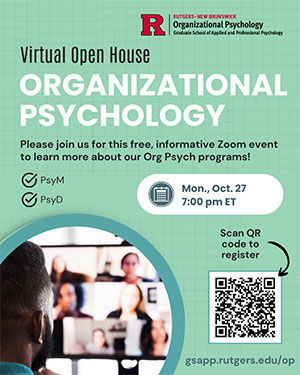
VIRTUAL OPEN HOUSE - Mon, Oct 27th 7:00 pm ET
 The Consortium for Research on Emotional Intelligence in Organizations is headquartered within the Organizational Psychology Program at Rutgers University and provides students with the unique opportunity to conduct research and collaborate with and learn from leading experts in the field of emotional intelligence. The Organizational Psychology program is currently accepting applications for our Doctoral (PsyD) and Master's (PsyM) programs for matriculation in Fall 2026. Click here or scan the QR code below to register for our virtual open house to learn more.
NEW Research Fellowship
think2perform Research Institute’s Research Fellowship program invites proposals from doctoral candidates, post-docs and junior faculty pursuing self-defined research focused on moral intelligence, purpose, and/or emotional intelligence. Click here for more information.
Listen to Consortium member Chuck Wolfe interview some of the thought leaders in emotional intelligence.
Harvard Alumni Panel - Why is interest in Emotional Intelligence Soaring?
Consortium member Chuck Wolfe hosts a panel of world class leaders in the field of emotional intelligence (EI) to talk about why interest in EI is soaring. Panel members include EI Consortium members Dr. Richard Boyatzis, Dr. Cary Cherniss and Dr. Helen Riess. Click here to view the panel discussion.
Interview with Dr. Cary Cherniss and Dr. Cornelia Roche
Host, Chuck Wolfe interviews Drs. Cary Cherniss and Cornelia Roche about their new book Leading with Feeling: Nine Strategies of Emotionally Intelligent Leadership. The authors share powerful stories of cases involving outstanding leaders using strategies that can be learned that demonstrate effective use of emotional intelligence. Click here to see the interview.
Interview with Dr. Rick Aberman
See Chuck Wolfe interview Consortium member and sports psychologist Dr. Rick Aberman on peak performance and dealing with the pandemic. The interview is filled with insights, humorous anecdotes, and strategies for achieving peak performance in athletics and in life. Click here to see the interview.
Interview with Dr. David Caruso
Chuck Wolfe interviews Consortium member David Caruso talking about their work together, the ability model of emotional intelligence, and insights into how to use emotional intelligence to address staying emotionally and mentally healthy during times of crisis and uncertainty. Click here to listen to the interview.
Interview with Dr. Richard Boyazis
How can you help someone to change? Richard Boyatzis is an expert in multiple areas including emotional intelligence. Richard and his coauthors, Melvin Smith, and Ellen Van Oosten, have discovered that helping people connect to their positive vision of themselves or an inspiring dream or goal they've long held is key to creating changes that last. In their book Helping People Change the authors share real stories and research that shows choosing a compassionate over a compliance coaching approach is a far more engaging and successful way to Helping People Change. Click here to listen to the interview.
Interview with Dr. Marc Brackett
Marc Brackett, Director of the Yale Center for Emotional Intelligence, has written a wonderful book about feelings. I worked with Marc when he was first crafting his world class social and emotional learning program, RULER. Our interview highlights how Marc has achieved his own and his Uncle's vision for encouraging each of us to understand and manage our feelings. My conversation with Marc is inspiring, humorous, and engaging at times. Click here to listen to the interview.
Interview with Dr. Helen Riess
Helen Riess is a world class expert on empathy. She is an associate clinical professor of psychiatry at Harvard Medical School and director of the Empathy and Relational Science Program at Mass General Hospital. Helen discusses her new book and shares insights, learnings and techniques such as the powerful seven-step process for understanding and increasing empathy. She relates information and cases whereby she uses empathy to make a meaningful difference in areas such as parenting and leading. Click here to listen to the interview.
Interview with Dr. Maurice Elias
The show is about the Joys and Oys of Parenting, a book written by a respected colleague, Dr. Maurice Elias, an expert in parenting and emotional and social intelligence. Dr. Elias wrote a book tying Judaism and emotional intelligence together to help parents with the challenging, compelling task of raising emotionally healthy children. And while there are fascinating links to Judaism the book is really for everybody. Click here to listen to the interview.
Interview with Geetu Bharwaney
Challenges abound and life is stressful for many. So how do we cope? Chuck Wolfe interviews Geetu Bharwaney about her book, Emotional Resilience. Geetu offers research, insights, and most importantly practical tips for helping people bounce back from adversity. Click here to listen to the interview.
Interview with Dr. Daniel Goleman
Listen to an interview by with Dr. Goleman on his new book Focus: The Hidden Driver of Excellence. In the book Dan helps readers to understand the importance and power of the ability to focus one's attention, will power, and cognitive control in creating life success. Click here to listen to the interview.
Interview with Dr. John Mayer
How Personal Intelligence Shapes Our Lives: A Conversation with John D. Mayer. From picking a life partner, to choosing a career, Jack explains how personal intelligence has a major impact on our ability to make successful decisions. Click here to listen to the interview.
Interview with Dr. Cary Cherniss
Click HERE to listen to an interview with Dr. Cary Cherniss co-chair of the EI Consortium. Dr. Cherniss discusses the issue of emotional intelligence and workplace burnout.
Interview with Dr. Marc Brackett
Click HERE to listen to an interview with Dr. Marc Brackett, the newly appointed leader of the Center of Emotional Intelligence which will begin operation at Yale University in April, 2013. In this interview Dr. Brackett shares his vision for the new center.
